



10 Apr WRT License in Malaysia: Complete Guide for Foreign-Owned Businesses (2026)

A Wholesale Retail Trade (WRT) license is a mandatory business permit for foreign-owned companies conducting retail, wholesale, import/export, F&B, or franchise operations in Malaysia.
If your company has more than 50% foreign equity and you plan to sell goods, you cannot legally operate without one.
But here’s what most guides don’t tell you: For foreign-owned retail and trading companies, a WRT approval is a mandatory prerequisite before Immigration will process your DP10 Employment Pass application.
Your WRT license is not just a trading permit. It is the first domino in unlocking your ability to work legally in Malaysia.
The licensing-to-visa pipeline works like this:
- Incorporate your Sdn. Bhd. with SSM
- Secure your PBT Premises License from the local town council
- Obtain your WRT License from KPDN
- Apply for your DP10 Employment Pass through Immigration
Miss one step, and the entire sequence stalls.
At Moore Bzi, we have over 20 years of experience guiding foreign businesses through Malaysian licensing and compliance.
As an ISO 9001:2015 certified firm and authorised agent under the Malaysia My Second Home (MM2H) Programme, and Malaysia Premium Visa Programme (PVIP) we have firsthand insight into where applications commonly get stuck, which mistakes lead to rejection, and how to structure your setup so that WRT approval transitions smoothly into work permit eligibility.
This guide shares what we have learned from helping hundreds of foreign entrepreneurs establish compliant operations in Malaysia.
This article is written for foreign-owned distributive trade businesses. If your primary revenue comes from services/consulting rather than products, you likely need a USS license instead. We also cover the difference between these two licenses in this article.
What Is a WRT License?
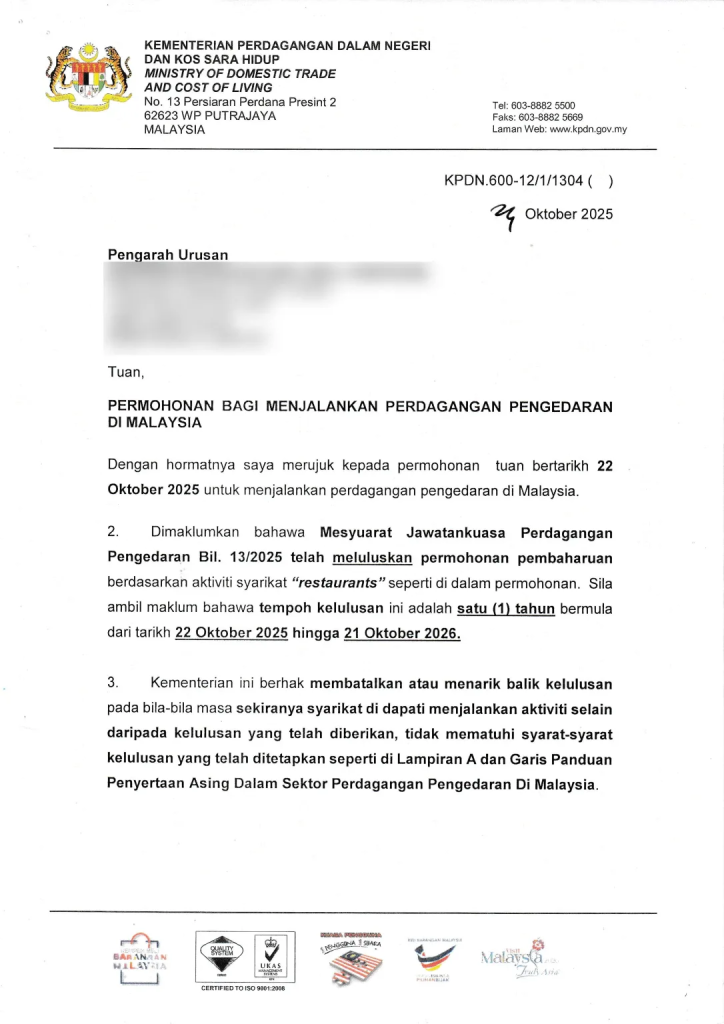
Sample of WRT License
MISHU
A Wholesale Retail Trade (WRT) license is a business permit issued by KPDN (Ministry of Domestic Trade and Cost of Living) that authorises foreign-owned companies to participate in Malaysia’s distributive trade sector.
The license covers retail, wholesale, import/export, franchising, and F&B operations. It is valid for 1-2 years and is renewable.
WRT stands for Wholesale Retail Trade, but the scope is broader than the name suggests. Restaurants, franchise outlets, and trading companies all fall under WRT.
Applications are submitted through the BLESS portal (Business Licensing Electronic Support System). KPDN uses this license to regulate foreign participation in local trade, protect Malaysian SMEs, and encourage sector modernisation.
There are four WRT categories, each with different capital requirements:
| Category | Business Type | Minimum Paid-Up Capital |
| Hypermarket | Large-format retail (5,000 sqm or more) | RM50,000,000.00 |
| Superstore | Medium-format retail (3,000 to 4,999 sqm) | RM25,000,000.00 |
| Departmental Store | Multi-category retail | RM20,000,000.00 |
| Other Distributive Trade | Retail, wholesale, import/export, F&B, franchise | RM1,000,000.00 |
Most foreign-owned businesses fall into the “Other Distributive Trade” category, which requires RM1,000,000 in paid-up capital.
Who Needs a WRT License?
Foreign-owned companies with more than 50% shares held by non-Malaysians must obtain a WRT license before engaging in any distributive trade activity.
The 50% foreign ownership threshold is the trigger. Once your company crosses this line, WRT becomes mandatory for any business that sells products.
Business types requiring WRT include:
- Retail shops and outlets
- Wholesale distribution
- Import/export trading
- Restaurants and F&B operations
- Franchise businesses
Companies with 51% or more Malaysian ownership may be exempted from WRT requirements. However, this exemption is discretionary, not guaranteed. KPDN officers assess each case individually.
If your business is service-based (consultancy, IT services, marketing), you need a USS license instead of WRT. We explain the distinction in the next section.
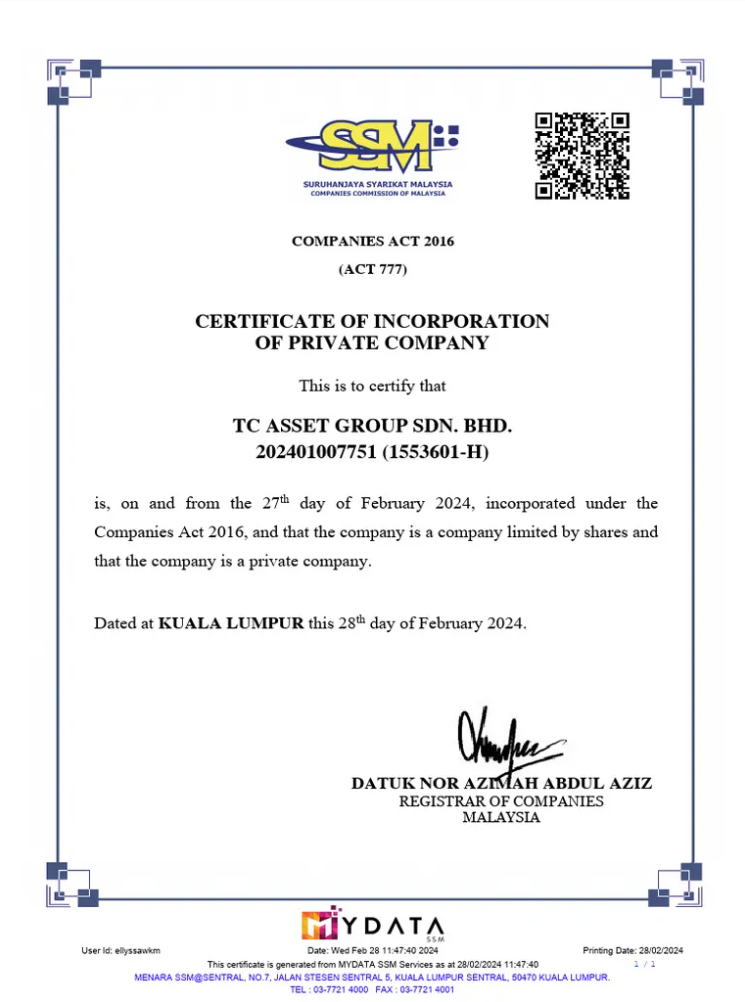
Before applying for WRT, you must first have a registered Sdn. Bhd. Your company registration in Malaysia must be completed with SSM before any license application can proceed.
Sample of SSM Certification
Restricted sectors for foreigners:
| Restricted Category | Examples |
| Protected retail | Supermarkets, mini-markets, provision shops, sundry shops |
| Local services | Hair salons, laundry, vehicle workshops, cybercafés |
| Strategic sectors | Petrol stations, textile shops, furniture shops |
| Non-exclusive F&B | Cafes and restaurants competing with local hawkers |
If your foreign-owned company also plans to hire expatriates, you should also understand the types of work permit in Malaysia and the broader foreigner work permit process in Malaysia.
WRT vs USS: Which License Do You Need?
WRT licenses are for businesses primarily selling products. USS licenses are for businesses primarily providing services.
Applying for the wrong license triggers automatic rejection and a 2-3 month restart. In our 20+ years handling foreign business applications, this remains the single most common mistake we see. We estimate that roughly one in five first-time applicants selects the wrong license type.
The deciding factor is your primary revenue source.
Decision rule:
- Primary revenue from selling products → WRT
- Primary revenue from providing services → USS
- Mixed businesses → Apply based on dominant revenue source (>50%)
A restaurant sells food (products), so it needs WRT. A consultancy company sells expertise (services), so it needs the USS.
For mixed businesses, assess where more than half your revenue comes from. If 60% of revenue is product sales and 40% is service fees, apply for WRT.
WRT vs USS comparison:
| Dimension | WRT License | USS License |
| Primary Activity | Selling products | Providing services |
| Capital Requirement | RM1,000,000 | RM1,000,000 |
| Examples | Retail, wholesale, F&B, trading | Consultancy, other services, marketing |
| Application Portal | BLESS | BLESS |
| Processing Time | 2-4 months | 2-4 months |
The capital difference is significant. WRT requires RM1,000,000; USS requires only RM500,000.
Latest Posts



Ready to discuss your WRT application?
Moore Bzi can confirm which license you need, review your documents for gaps, and map out your realistic timeline before you submit.

WRT License Requirements
WRT requirements fall into three categories: paid-up capital, business premises, and documentation.
1. Paid-Up Capital
Foreign-owned companies must have a minimum of RM1,000,000 in paid-up capital.
This amount must be reflected in your SSM records before you submit your WRT application. KPDN will verify your capital against SSM’s database.
If your company was incorporated with RM1 or RM100 capital (common with budget incorporation packages), you must inject additional capital and wait 1-2 weeks for SSM records to update before applying.
Companies with 51% Malaysian ownership may face reduced or eliminated capital requirements, but this is discretionary.
2. Business Premises
You must have a physical office address. A virtual office in Malaysia is not accepted for WRT applications.
Premises requirements:
- Valid tenancy agreement (minimum 12 months)
- Commercial-zoned property
- Active local telephone line registered to the company
- Premises may be subject to KPDN inspection
3. Document Checklist
| Document | Common Issues |
| WRT 1 Application Form | Incomplete fields, inconsistencies with other documents |
| Company Profile / Business Plan | Too vague; lacks business model detail |
| SSM Forms (Sec 9, 24, 49, 14) | Outdated; does not match capital claims |
| LHDN Tax Registration | Company not yet registered with tax authority |
| Tenancy Agreement | Less than 12 months validity; not commercial-zoned |
| Premises Photos | Poor quality; does not show operational readiness |
| Local Phone Bill | Not registered in company name |
| Director/Shareholder ID Copies | Expired passport; unclear copies |
Every document must be consistent. If your SSM forms show RM100,000 capital but your application claims RM1,000,000; or if your SSM forms show RM1million paid up capital but no actual injection of the capital proven by bank statements, then expect rejection from the KPDN.
Since business licence requirements in Malaysia can differ by industry and location, WRT may not be the only approval your company needs.
How to Apply for a WRT License: Step by Step
Submit your WRT application through BLESS (bless.gov.my), Malaysia’s online business licensing portal.
Step 1: Prepare Documents
Gather all items from the checklist above. Ensure your SSM records reflect the correct paid-up capital before proceeding.
Step 2: Register on BLESS Portal
Create an account at bless.gov.my. Verify your company details match your SSM registration.
Step 3: Complete WRT 1 Form
Fill all fields accurately. Cross-check every entry against your supporting documents for consistency.
Step 4: Upload Documents
Submit all required attachments in accepted formats (typically PDF). Ensure files are clear and legible.
Step 5: Submit Application
Review everything before submitting. Note your reference number for tracking.
Step 6: Premises Inspection
KPDN may schedule a site visit. Not all applications require inspection, but be prepared.
Step 7: Receive Approval
Once approved, your WRT license is issued. It is valid for 1-2 years.
Important: There is no government fee for WRT license applications. KPDN does not charge. Costs you see quoted are consultancy or agent fees, not official charges.
Processing Time: What to Realistically Expect
WRT license processing typically takes 2-4 months.
Best-case scenarios with complete documents and no inspection can be completed in 6-8 weeks. Complex cases or inspection delays can extend to 3-4 months.
Timeline breakdown:
| Stage | Duration | Variables |
| Document Preparation | 2-4 weeks | Capital registration, premises setup, gathering documents |
| BLESS Submission | 1 day | None |
| KPDN Review | 4-8 weeks | Industry complexity, queue length, document completeness |
| Premises Inspection | 1-2 weeks | If required; depends on scheduling availability |
| Final Approval | 1 week | None |
| Total Range | 2-4 months | Plan for 3 months realistically |
These timelines reflect what we typically see across our client portfolio. Straightforward applications with complete documentation and responsive applicants tend to fall on the shorter end.
Cases involving F&B exclusivity reviews or multi-stakeholder ownership structures often take longer.
Why do timelines vary so much? Three factors: document completeness, whether inspection is required, and industry complexity.
You will find conflicting information online. Some guides claim 1-2 months; others say 3-4 months. The variance depends on your specific situation.
For renewals: Submit your renewal application at least 3 months before your license expires to avoid gaps in coverage.
Common Challenges and How to Avoid Them
After processing hundreds of WRT applications over two decades, we see the same mistakes regularly. Each one is avoidable with proper preparation.
1. Applying for the Wrong License Type (WRT vs USS)
This triggers automatic rejection and a 2-3 month restart.
Fix: Use the decision rule from the WRT vs USS section. If uncertain, consult a professional before applying.
2. Insufficient Paid-Up Capital in SSM Records
Your application shows RM1,000,000, but SSM records show RM100.
Fix: Inject capital and wait 1-2 weeks for SSM records to update before submitting your WRT application.
3. Incomplete or Inconsistent Documentation
One document says one thing; another contradicts it.
Fix: Work through the checklist systematically. Cross-check every document for consistency before submission.
4. Premises Issues During Inspection
The premises are residential-zoned, not properly set up, or lack required signage.
Fix: Ensure your premises are commercial-zoned and operationally ready. For retail and F&B, signage may be required.
5. Underestimating the Timeline
You commit to a launch date before receiving WRT approval.
Fix: Plan for 3 months minimum. Do not sign binding commitments until your license is in hand.
6. Operating Before Approval is possible
You start trading while waiting for your license.
Special Requirements for Restaurants and F&B

Yes, foreigners can open restaurants in Malaysia with a WRT license.
But KPDN requires foreign F&B businesses to demonstrate “exclusivity.” Generic concepts that compete directly with local hawkers face high rejection rates.
What KPDN Looks For
KPDN evaluates whether your restaurant offers something unique that is not readily available from local operators.
Exclusivity indicators:
- Unique cuisine documentation (not widely available locally)
- Chef credentials (3+ years experience in the specific cuisine)
- Premium positioning (pricing, target market, ambience)
- Menu samples and concept presentation
Why Restaurant Applications Get Rejected
- Generic café concepts with no differentiation
- Common cuisines already widely available in Malaysia
- Perceived direct competition with local hawkers
- Lack of chef qualifications or cuisine expertise documentation
Practical tip: Position your restaurant as bringing something genuinely new to Malaysia. This could be a specific regional cuisine, a dining concept, or an expertise level that local operators do not offer.
WRT License and Work Permits: The Connection Most Guides Miss
WRT license approval is typically required before Immigration will process your DP10 Employment Pass application.
For foreign-owned distributive trade companies, WRT is a prerequisite in the compliance pipeline. It is not a separate, optional process.
This is also why employers should understand both the Employment Pass in Malaysia and the broader process of hiring expatriates in Malaysia, since work authorization only moves forward after the company has completed the required licensing, ESD, and position-approval steps.
The licensing-to-visa sequence:
- Incorporate Sdn. Bhd. (SSM registration)
- Secure Business Premises License (Local PBT)
- Obtain WRT License (KPDN approval)
- Apply for DP10 Employment Pass (Immigration via ESD registration)
No WRT means no work permit processing for foreign-owned trading companies.
This dependency is why foreigners should care about WRT beyond trading compliance. Your ability to legally work in your own company depends on it.
Plan your timeline accordingly. WRT delays cascade directly into work permit delays, and they can also affect the wider expatriate hiring process, including ESD registration, position approval, and passport endorsement.
Why Choose Moore Bzi
Moore Bzi has guided foreign businesses through WRT applications since before the BLESS portal existed.
20+ Years Navigating Malaysian Compliance
We are an ISO 9001:2015 certified firm specialising in permit application services. Moore Bzi is also an authorised agent under the Malaysia My Second Home (MM2H) Programme, sanctioned by the Malaysian Ministry of Tourism.
Over two decades, we have built deep working relationships with KPDN, Immigration, and SSM. We have seen policy changes, portal migrations, and shifting requirements. Our processes have adapted with each change.
We know where applications get stuck. We know which documentation gaps trigger rejection. And we know how to structure your setup so that WRT approval flows smoothly into the work permit eligibility process.
End-to-End WRT Application Support
What we handle:
- WRT vs USS determination (confirm the correct license before you apply)
- Document preparation and review (catch errors before submission)
- BLESS portal submission and follow-up
- KPDN liaison and inspection coordination
- Work permit application support (the next step after WRT)
Beyond WRT: Your Full Compliance Partner
WRT is often just one piece of the puzzle. Foreign entrepreneurs typically need multiple licenses and permits to operate legally and work in their own company.
Moore Bzi supports the full compliance chain:
- Company registration in Malaysia
- ESD registration
- Employment Pass applications
- Business premises licensing
We have helped MNCs, SMEs, and solo founders navigate this system. Whether you are opening a single retail outlet or establishing a regional distribution hub, the compliance pathway is the same.
Ready to discuss your WRT application?
Moore Bzi can confirm which license you need, review your documents for gaps, and map out your realistic timeline before you submit.
Conclusion
A WRT license is mandatory for foreign-owned distributive trade businesses in Malaysia.
But it is also your gateway to work permits. Without WRT, Immigration will not process your DP10 Employment Pass application.
Key points to remember:
- RM1,000,000 paid-up capital must be in SSM records before you apply
- Physical premises required (virtual office not accepted)
- WRT is for products; USS is for services (wrong license means rejection)
- Plan for 3 months processing time
- Do not operate before approval
The decision rule is simple: If your primary revenue comes from selling products and you have more than 50% foreign ownership, you need WRT. If you are unsure about any step, get professional guidance before you submit.
Frequently Asked Questions
What is a WRT license in Malaysia?
A WRT license is a mandatory business permit from KPDN for foreign-owned companies (more than 50% foreign equity) conducting retail, wholesale, import/export, franchise, or F&B operations in Malaysia. The license is valid for 1-2 years and must be renewed before expiry.
What does WRT stand for?
WRT stands for Wholesale Retail Trade. However, the license covers more than the name suggests, including restaurants, franchise businesses, and import/export trading companies.
Who needs a WRT license?
Foreign-owned companies with more than 50% foreign shares engaging in distributive trade activities. Companies with 51% or more Malaysian ownership may be exempted, but exemption is discretionary and assessed case by case.
What is the minimum paid-up capital for WRT?
RM1,000,000 for the standard WRT category (Other Distributive Trade). This amount must be reflected in your SSM records before you submit your application.
Can I be exempted from WRT requirements?
Companies with 51% or more Malaysian ownership may be exempted. However, this is not guaranteed. KPDN officers assess each case individually based on business type and ownership structure.
What is the difference between WRT and USS?
WRT is for businesses that primarily sell products. USS is for businesses that primarily provide services. Applying for the wrong license results in automatic rejection and a 2-3 month restart.
How long does WRT approval take?
Typically 2-4 months. Best-case scenarios with complete documents can be 6-8 weeks. Complex cases or those requiring inspection may extend to 3-4 months. Plan for 3 months realistically.
Is there a government fee for WRT?
No. KPDN does not charge application fees for WRT licenses. Costs you see quoted are consultancy or agent fees, not official government charges.
Can foreigners open restaurants in Malaysia?
Yes, but KPDN requires foreign F&B businesses to demonstrate “exclusivity.” Generic café concepts or cuisines widely available locally face high rejection rates. You must show unique cuisine, chef credentials, or premium positioning.
Do I need WRT before applying for a work permit?
Yes. WRT approval is typically required before Immigration processes DP10 Employment Pass applications for foreign-owned trading companies. No WRT means no work permit processing.