



23 Apr Best Business Entity for Foreigners in Malaysia: A Comparison Guide (2026)

Foreign investors have four main options for establishing a business presence in Malaysia: Private Limited Company (Sdn Bhd), Labuan International Company, Branch Office, or Representative Office.
Each serves a different purpose and carries different implications for taxation, liability, and your ability to obtain a work visa.
For most foreign investors planning to operate and live in Malaysia, a Private Limited Company (Sdn Bhd) is the best choice.
It allows 100% foreign ownership in most sectors, provides limited liability protection, and is the only mainstream structure that enables Employment Pass sponsorship for business owners.
Choosing the wrong structure can leave you legally stranded or paying unnecessary taxes for years.
The question is not “which entity is cheapest to set up?” The question is: “which entity matches my commitment level, my business model, and my visa needs?”
This is where most online guides fall short. They explain what each entity is. They do not tell you which one to choose based on your specific situation.
This guide does.
We will walk through each structure, compare them side by side, and give you clear decision rules: if you need X, choose Y. No hedging. No “it depends” without explanation.
This article covers:
- The four entity options and what each signals about your commitment level
- Deep-dive into Sdn Bhd, Labuan, Branch Office, and Representative Office
- A side-by-side comparison table across ownership, visa eligibility, tax, and compliance
- Decision rules by visa needs, revenue model, and business type
- Industry restrictions that affect foreign ownership
- Frequently asked questions with direct answers
Key Takeaways
- Sdn Bhd is the default for most foreign investors. It is the mainstream structure that enables Employment Pass sponsorship, allowing you to live and work in Malaysia.
- Labuan suits international businesses only. If you serve Malaysian customers or transact in Ringgit, Labuan’s 3% tax advantage likely does not apply to you.
- Branch Offices carry parent company liability. They can sponsor Employment Passes for owners under the same ESD, and registration fees scale with your parent company’s global capital.
- Representative Offices cannot generate revenue. They exist purely for market research and relationship-building. Two-year validity, renewable twice (up-to a total of 5 years). It can also be used to sponsor Employment Pass by registering with the ESD.
- Timeline reality: SSM registration takes 3 to 5 working days. Becoming fully operational, with a bank account, licences, ESD registration, and Employment Pass, takes 30 to 60 working days minimum.
- Decision rule: Need to live in Malaysia? Choose Sdn Bhd. Testing the market without revenue? Representative Office. Serving only international clients with substance on Labuan Island? Labuan Company.
The Four Entity Options for Foreign Investors
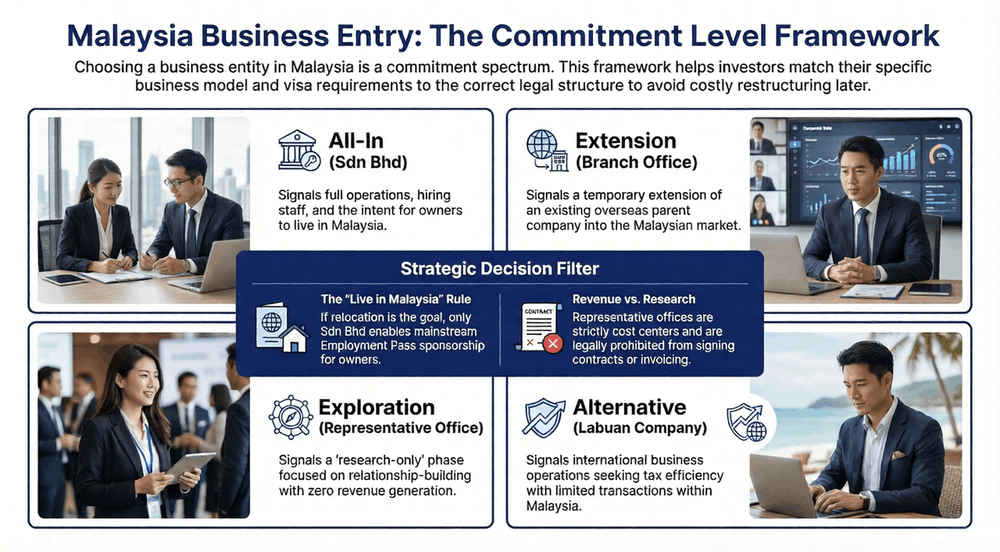
Foreign investors in Malaysia can choose from four main business structures. Each serves a different level of commitment to the Malaysian market.
Think of entity choice as a commitment spectrum, not a list of interchangeable options.
| Commitment Level | Entity Type | What It Signals |
| All-In | Sdn Bhd | Full operations, living in Malaysia, hiring local and foreign staff |
| Extension | Branch Office | Extending existing overseas business into Malaysia temporarily |
| Exploration | Representative Office | Market research and relationship-building, no revenue |
| Alternative | Labuan Company | International business with tax efficiency, limited Malaysia transactions |
This framework helps you immediately identify where you sit on the spectrum before reading detailed requirements.
Let us examine each option in detail, starting with the structure most foreign investors choose: the Private Limited Company.
Private Limited Company (Sdn Bhd): The All-In Option

For most foreign investors planning to operate and live in Malaysia, a Private Limited Company (Sdn Bhd) is the best choice.
It allows 100% foreign ownership in most sectors, provides limited liability protection, and is the mainstream structure that enables Employment Pass sponsorship for business owners.
Why Most Foreign Investors Choose Sdn Bhd
If you want to live and work in Malaysia as a business owner, you need an Employment Pass. Usually an Sdn Bhd, or in limited cases a Labuan Company, can sponsor this visa.
LLPs, and sole proprietorships cannot sponsor Employment Passes for owners.
This single fact eliminates most alternatives for foreign investors who plan to relocate. Your entity choice is your immigration pathway.
The Expatriate Services Division (ESD) guidelines explicitly require a locally incorporated Sdn Bhd with sufficient paid-up capital for EP sponsorship.
Thinking about the employment pass process? Learn how the employment pass in Malaysia works, including eligibility requirements, salary thresholds, and processing timelines.
Ownership, Directors, and Compliance Requirements
Under the Companies Act 2016, foreigners can own 100% of an Sdn Bhd in most industries. There is no general requirement for a local partner or local equity participation.
This is a common misconception. Many investors assume they need a Malaysian partner to start a business. In most sectors, you do not.
However, certain sectors have equity restrictions: banking, telecommunications, and retail or wholesale with WRT requirements. Always verify your specific industry.
Every Sdn Bhd must have at least one director who ordinarily resides in Malaysia. This can be yourself if you obtain an EP, a local business partner, or a nominee director.
You must also appoint a licensed company secretary within 30 days of incorporation.
The resident director requirement is non-negotiable. But it does not require giving away equity.
Ready to incorporate? Explore company registration in Malaysia, including the documents you need, typical timelines, and how to structure your paid-up capital correctly.
Tax Treatment for Sdn Bhd Companies
Sdn Bhd companies pay corporate tax at 24% on chargeable income.
SMEs meeting certain criteria pay 17% on the first RM600,000.
Malaysia operates a territorial tax system. Only income derived from Malaysia is taxable.
This rate is higher than Labuan’s 3%. But Sdn Bhd has no restrictions on transacting with Malaysian customers.
When Sdn Bhd Is NOT the Right Choice
If you are purely serving international clients with no Malaysian customers, a Labuan Company may be more tax-efficient.
If you are only conducting market research with no revenue, a Representative Office is simpler.
If you are extending an existing overseas parent company temporarily, a Branch Office may suffice, though it carries liability implications.
Sdn Bhd is the default, not the universal answer.
A note from our experience: At Moore Bzi, we have helped foreign investors register companies in Malaysia for over 20 years. The question we hear most often: “Can I actually live in Malaysia after setting up?” The answer is yes, if you choose the right structure and meet capital requirements.
Latest Posts



Ready to Set Up Your Sdn Bhd?
We handle company registration, ESD registration and Employment Pass applications as one coordinated process, so you are operational faster.

Labuan International Company: The Tax-Efficient Alternative

Labuan companies are often marketed as a low-tax alternative to Sdn Bhd. The reality is more nuanced. Labuan suits specific investor profiles, and many businesses discover the restrictions outweigh the tax savings.
What Makes Labuan Different
Labuan trading companies pay just 3% tax on net profits, or a flat RM20,000, whichever is higher.
Labuan holding companies pay 0% on dividends and capital gains from foreign investments.
Compared to Sdn Bhd’s 24% corporate tax rate, this is a significant difference for profitable international businesses.
But this advantage only applies if you are conducting international business. Transacting with Malaysian residents in Ringgit triggers standard Malaysian tax rates.
Substance Requirements Are Real
Labuan companies must maintain economic substance on Labuan Island: a physical office, at least two full-time employees based in Labuan, and adequate operating expenditure.
The Labuan Financial Services Authority (FSA) audits compliance.
Some promoters downplay substance requirements. In reality, maintaining a Labuan office and staff adds operational costs that may offset tax savings for smaller businesses.
Substance audits have increased since 2019.
Restrictions on Malaysian Transactions
Labuan companies face restrictions when dealing with Malaysian residents. Transactions in Ringgit with Malaysian parties may trigger “deemed onshore” status, subjecting profits to standard Malaysian taxation.
If your business model involves Malaysian customers, suppliers, or partners, Labuan’s tax benefits may not apply. Sdn Bhd becomes the simpler choice.
Labuan Work Permits
Labuan companies can sponsor work passes, but these are Labuan-specific permits, not standard Employment Passes.
Holders are authorised to work for the Labuan entity, with some flexibility for peninsular Malaysia business activities.
If your primary base will be Kuala Lumpur or Peninsular Malaysia, an Sdn Bhd with a standard Employment Pass provides clearer authorisation.
Who Should Consider Labuan
Labuan suits businesses that are genuinely international: trading between countries, holding foreign investments, or providing services to non-Malaysian clients.
Think regional holding companies, international trading firms, or investment vehicles.
Decision rule: If more than 50% of your revenue will come from Malaysian customers, Sdn Bhd is likely the better choice despite the higher tax rate.
Branch Office: Extending Your Overseas Business

A Branch Office is not a separate legal entity. It is an extension of your overseas parent company into Malaysia. This means faster setup for established businesses, but it also means your parent company bears full liability for Malaysian operations.
Both Branch Offices and Representative Offices can sponsor and register with ESD, enabling the hiring of foreign employees.
How Branch Offices Work in Malaysia
Unlike an Sdn Bhd, a Branch Office does not create a new Malaysian company. It is simply an extension of your foreign parent company registered with SSM to operate in Malaysia.
Your overseas parent company is fully liable for all debts, contracts, and legal issues arising from Malaysian operations. There is no liability shield.
Registration fees with SSM are calculated based on the parent company’s global share capital. For large parent companies, this cost can be substantial and may not be justified for a market entry.
Limitations: No EP Sponsorship, Sector Restrictions
Branch Offices can sponsor Employment Passes for directors or owners. Staff can be employed and sponsored, and the foreign business owner can obtain a visa through the Branch Office structure after registering with the ESD.
If you need to live in Malaysia to run the operation, a Branch Office does not solve your visa problem.
Branch Offices also face restrictions in certain sectors, particularly retail and wholesale trade. WRT licensing is more complex for Branch Offices than for locally incorporated Sdn Bhd companies.
Planning to trade goods in Malaysia? Understand the types of business licence in Malaysia and which ones apply to your sector before choosing your entity structure.
When Branch Office Makes Sense
Branch Offices suit established multinational corporations extending existing operations into Malaysia temporarily, where the parent company wants direct control and is comfortable with liability exposure.
Decision rule: If you are a startup or SME founder who needs to live in Malaysia, a Branch Office does not meet your needs.
Representative Office: Testing the Market

A Representative Office, also called a Regional Office or RERO, is strictly a cost centre. It allows foreign companies to conduct market research, build relationships, and explore opportunities in Malaysia.
But it cannot sign contracts, issue invoices, or generate any revenue.
What a Representative Office Can and Cannot Do
A Representative Office is legally prohibited from conducting commercial activities in Malaysia.
It cannot sign contracts, issue invoices, collect payments, or generate any form of revenue. Its permitted activities are limited to market research, liaison, and coordination.
This is not a “light” version of a company. It is fundamentally different. If you need to transact, you need a different structure.
Set up through MIDA
Representative Offices are registered through the Malaysian Investment Development Authority (MIDA), not the Companies Commission (SSM).
The approval process involves demonstrating that your foreign parent company is established and the purpose is genuine market research.
Representative Office status is typically granted for two years, with the possibility of one renewal. After that, you are expected to either withdraw from Malaysia or upgrade to a full commercial entity.
No Employment Pass Sponsorship
Representative Offices cannot sponsor Employment Passes. Staff may be authorised under different arrangements, but the structure does not provide a pathway for business owners to obtain work visas.
If you need to live in Malaysia during the market research phase, you will need to explore other visa options, such as a Long-Term Social Visit Pass through family ties.
When to Graduate to a Full Entity
Once you have validated the market opportunity and are ready to transact, you will need to incorporate a Sdn Bhd or register a Branch Office. The Representative Office cannot convert. You start fresh.
Decision rule: Use a Representative Office only if you are genuinely in research mode with no revenue plans for 12 to 24 months.
Entity Comparison Table: Side-by-Side Analysis
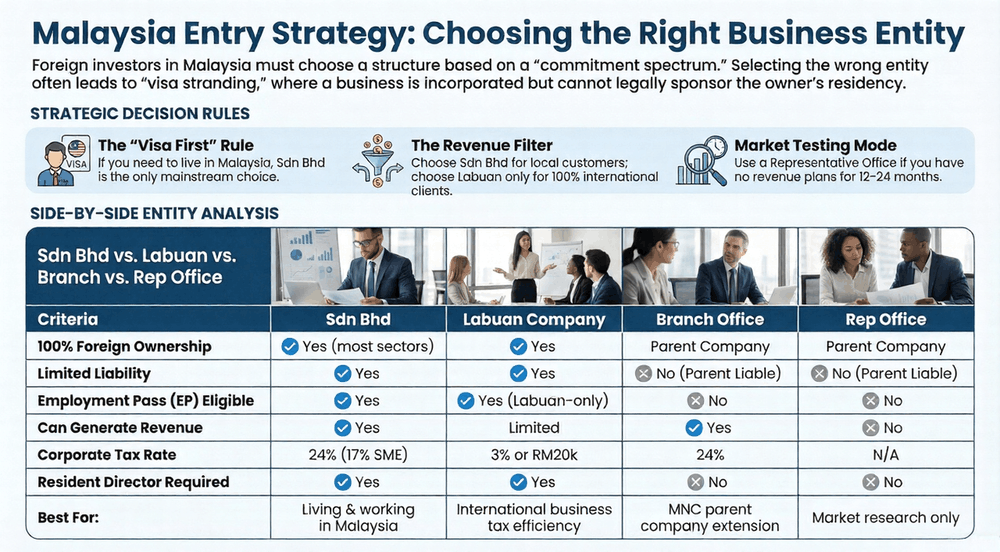
The following table compares all four entity options across the criteria that matter most to foreign investors.
| Criteria | Sdn Bhd | Labuan Company | Branch Office | Representative Office |
| Foreign Ownership | 100% (most sectors) | 100% | Parent company | Parent company |
| Separate Legal Entity | Yes | Yes | No | No |
| Limited Liability | Yes | Yes | No (parent liable) | No (parent liable) |
| Employment Pass Eligible | Yes | Yes (Labuan WP) | No | No |
| Can Generate Revenue in Malaysia | Yes | Limited (restrictions apply) | Yes | No |
| Can Transact in Ringgit | Yes | Restricted | Yes | N/A |
| Corporate Tax Rate | 24% (17% SME rate available) | 3% trading / 0% holding | 24% | N/A (no revenue) |
| Resident Director Required | Yes (1 minimum) | Yes (Labuan-based) | No | No |
| Substance Requirements | Standard compliance | Office + 2 staff on Labuan | Parent company standards | Minimal |
| Setup Timeline | 3-5 days (SSM) + 30-60 days operational | 2-4 weeks | 2-4 weeks | 2-4 weeks (MIDA) |
| Best For | Full operations, living in Malaysia | International business, tax efficiency | MNC parent extension | Market research only |
How to read this table: Start with the “Employment Pass Eligible” row if visa is your priority. Then check “Can Generate Revenue” and “Corporate Tax Rate” based on your business model.
Not sure which structure applies to your situation? Our team has guided foreign investors through this decision for over 20 years. Contact us for a consultation.
Which Entity Should You Choose? Decision Framework
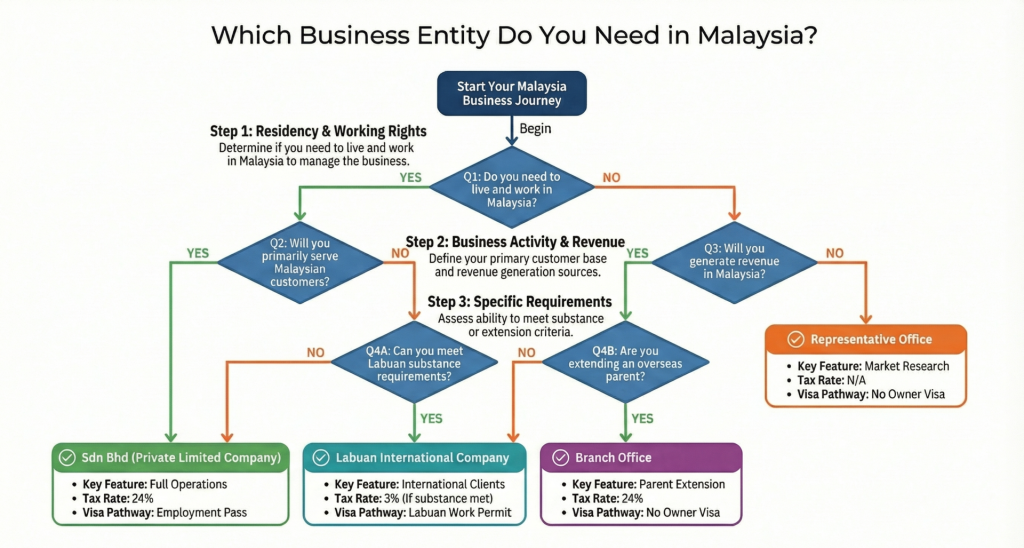
Choosing the right entity comes down to three questions: Do you need to live in Malaysia? What is your primary revenue source? And what is your commitment level?
Here are clear decision rules for the most common scenarios.
Decision Rules by Visa Needs
If you need to live and work in Malaysia: Choose Sdn Bhd. It is the only mainstream structure that enables Employment Pass sponsorship for business owners. Labuan’s work permit is an alternative but restricts you to Labuan-based operations.
If you will manage remotely without relocating: Any structure can work, but you must still appoint a resident director for Sdn Bhd. Consider whether you need revenue-generating capability.
Confused about visa options? Our guide on foreigner work permit explains the different categories, eligibility requirements, and how entity choice affects your application.
Decision Rules by Revenue Model
If you will transact with Malaysian customers: Choose Sdn Bhd. Labuan’s restrictions on Malaysian transactions make it unsuitable. Branch Office is possible but carries liability concerns.
If you will serve only international clients: Consider Labuan for tax efficiency, but only if you can meet substance requirements: office plus two staff on Labuan Island.
If you will not generate revenue in Malaysia: Representative Office is the simplest option for market research. Upgrade to Sdn Bhd when ready to transact.
Decision Rules by Commitment Level
All-In (full operations, hiring staff, living in Malaysia): Sdn Bhd is the clear choice. Build for the long term.
Extension (temporary project, parent company support): Branch Office if your parent company accepts liability. Otherwise, incorporate a subsidiary Sdn Bhd.
Exploration (testing before committing): Representative Office for pure research. If you need limited transactions, consider incorporating a minimal Sdn Bhd.
Alternative (international business, tax optimisation): Labuan if you genuinely serve international clients and can maintain substance.
The Most Common Mistake
We regularly see founders choose an entity based on setup speed or cost without considering visa implications.
They incorporate the “cheapest” structure, only to discover three months later it cannot sponsor their Employment Pass.
Restructuring later is expensive and time-consuming. Get it right the first time.
Still Unsure Which Entity Fits Your Situation?
Our team has guided company registration and visa applications for over 20 years. Tell us your business type and timeline, and we will map out your options.
Industry Restrictions Foreign Investors Should Know
Not all industries are equally open to foreign investment in Malaysia. While most sectors allow 100% foreign ownership, certain industries have equity restrictions, additional licensing requirements, or outright prohibitions.
Always verify your specific industry before incorporating.
Sectors with Equity Restrictions
Certain industries cap foreign ownership or require local equity participation:
- Banking and insurance: 30% foreign ownership cap
- Telecommunications: 49% foreign ownership cap
- Oil and gas (upstream): Restrictions apply
- Some professional services: May require local partnership
If your industry is restricted, a 100% foreign-owned Sdn Bhd may not be possible. You may need a joint venture with a Malaysian partner.
MIDA publishes sector-specific guidelines and equity policies.
When WRT Licensing Applies
If your company has any foreign shareholding and engages in wholesale, retail, trading, import/export, or food and beverage, you likely need a Wholesale Retail Trade (WRT) licence from KPDN.
Trading or retail business? Learn how the WRT licence works, what capital requirements apply, and how long the approval process takes.
WRT licensing adds compliance requirements and timeline. It is a common source of delays for foreign investors who do not anticipate it.
Fully Restricted Sectors
Some business activities are fully restricted to Malaysian citizens or Bumiputera ownership: mini-markets, sundry shops, petrol stations, wet markets.
If your business falls into these categories, foreign investment is not permitted regardless of entity structure.
How to Verify Your Industry Requirements
Check with MIDA for foreign equity policies, KPDN for WRT requirements, and relevant sector regulators: Bank Negara for finance, MCMC for telecommunications.
Or consult a professional advisor who can assess your specific situation.
Self-navigation is risky. The interplay between equity rules, licensing, and immigration creates complexity that benefits from professional guidance.
Conclusion
Entity choice is not just paperwork. It determines your tax obligations, your liability exposure, and whether you can live and work in Malaysia.
For most foreign investors planning to operate in Malaysia, an Sdn Bhd is the right answer. It provides 100% foreign ownership, limited liability, and Employment Pass eligibility.
Labuan works for international businesses that do not transact with Malaysian customers and can maintain substance on the island.
Branch Offices suit MNCs extending operations temporarily, but they cannot sponsor owner visas.
Representative Offices are strictly for market research with no revenue.
The most expensive mistake is choosing based on setup cost alone. We have seen founders incorporate the cheapest structure, only to discover months later they cannot get a visa, cannot open a bank account, or need to restructure entirely.
Why Moore Bzi
Moore Bzi has guided foreign investors through Malaysia market entry for over 20 years. We are not just an incorporation agent. We are compliance architects who anticipate the problems most founders only discover after it is too late.
- 20+ years serving foreign investors and MNCs in Malaysia
- Authorised MM2H agent under the Ministry of Tourism
- Full-service capability: company registration, ESD registration, Employment Pass applications, WRT licensing, company secretarial, and accounting
- Single point of contact from incorporation to operational readiness
- Proven process that connects SSM registration, banking, licensing, and immigration into one coordinated timeline
We do not just file paperwork. We engineer a complete business establishment for you
Let’s Discuss Your Malaysia Market Entry
Our team will recommend the right entity structure and outline your next steps, from incorporation to Employment Pass approval.
Frequently Asked Questions
Entity Selection
What is the best business entity for foreigners in Malaysia?
For most foreign investors, a Private Limited Company (Sdn Bhd) is the best choice. It allows 100% foreign ownership in most sectors, provides limited liability, and is the only mainstream structure that enables Employment Pass sponsorship for business owners. The right structure depends on whether you need to live in Malaysia, your target customers, and your tax situation.
What is the difference between Sdn Bhd and Labuan Company?
A Sdn Bhd is a standard Malaysian company that can transact freely with Malaysian customers and is taxed at 24%. A Labuan Company is a mid-shore structure taxed at 3% but restricted from transacting with Malaysian residents in Ringgit. Choose Sdn Bhd for Malaysian market operations. Choose Labuan for international business only.
Can foreigners register a sole proprietorship in Malaysia?
No. Sole proprietorships and conventional partnerships are restricted to Malaysian citizens and Permanent Residents. Foreigners must register a Sdn Bhd, LLP, Branch Office, or Representative Office. For most foreign investors, Sdn Bhd is the recommended structure because it provides limited liability and enables Employment Pass sponsorship.
Visa and Immigration
Can I get an Employment Pass as a business owner in Malaysia?
Yes, if you register a Sdn Bhd with sufficient paid-up capital and meet salary requirements. Your company must be registered with the Expatriate Services Division (ESD). The minimum paid-up capital depends on your industry and the number of expatriate positions you need. Branch Offices, Representative Offices, and LLPs cannot sponsor Employment Passes for owners.
Do I need to live in Malaysia to own a company there?
No. You can own 100% of a Sdn Bhd remotely. However, you must appoint at least one director who ordinarily resides in Malaysia. This can be a local partner or a nominee director. If you want to live and work in Malaysia yourself, you will need an Employment Pass sponsored by your company.
Setup and Process
How long does it take to register a company in Malaysia for foreigners?
SSM registration takes 3 to 5 working days. However, becoming fully operational takes 30 to 60 working days minimum. This includes opening a corporate bank account, obtaining business licences, completing ESD registration, and securing your Employment Pass if needed. Do not confuse quick incorporation with being ready to operate.
Do I need a local partner to start a business in Malaysia?
In most sectors, no. Foreigners can own 100% of a Sdn Bhd without a local partner. However, you must appoint a resident director who does not need to be a shareholder. Certain restricted industries, such as telecommunications and banking, may require local equity participation.
Compliance and Tax
What is the corporate tax rate for foreign-owned companies in Malaysia?
Standard corporate tax is 24% on chargeable income. SMEs meeting certain criteria pay 17% on the first RM600,000. Labuan trading companies pay 3%. Malaysia operates a territorial tax system, meaning only Malaysian-sourced income is taxable. Foreign-sourced income remitted to Malaysia is generally exempt.
What ongoing compliance is required for each entity type?
Sdn Bhd requires annual returns, audited accounts, AGM, tax filing, and company secretary maintenance. Labuan requires annual returns, substance audits, and Labuan FSA compliance. Branch Office requires parent company filings plus local returns. Representative Office requires annual MIDA reporting. All entities with foreign staff must maintain ESD compliance for work permits.