



28 Apr Employment Pass vs Professional Visit Pass Malaysia: 2026 Decision Guide

If you have spent the past hour reading EP vs PVP comparison articles and still cannot determine which pass applies to your situation, you are not alone.
Most guides frame this as a “long-term vs short-term” decision. That framing is incomplete, and it leads HR managers to apply for the wrong pass.
The main difference between Employment Pass and Professional Visit Pass is the employment relationship.
An Employment Pass is for foreign professionals employed and paid by a Malaysian company for ongoing roles.
A Professional Visit Pass is for foreign professionals who remain employed by an overseas company but are working temporarily in Malaysia on a specific project or assignment.
From 1 June 2026, new salary thresholds will take effect that significantly change EP eligibility. This makes the distinction more important than ever.
This guide walks you through the decision, updated for the June 2026 regulatory changes that most articles have yet to address.
Key Takeaways
The core distinction:
- Employment Pass = Malaysian employer, local salary, ongoing role
- Professional Visit Pass = Overseas employer, overseas salary, temporary assignment
June 2026 EP salary thresholds:
- Category I: RM20,000+ (dependants allowed, 5 years per term, 10 years cumulative)
- Category II: RM10,000 to RM19,999 (dependants allowed, succession plan required)
- Category III: RM5,000 to RM9,999 (dependants now allowed from June 2026, succession plan required)
PVP: No salary minimum, up to 12 months maximum, no dependants.
PVP-to-EP conversion:
Converting from PVP to EP requires a fresh EP application. The professional must exit Malaysia. Confirm applicable cooling-off requirements with ESD at the time of application.
Current fees:
EP costs RM2,000; PVP costs RM1,200 (both exclusive of 8% SST)
Decision rule: If paid by a Malaysian company, apply for EP. If paid by an overseas company for a temporary Malaysian assignment, apply for PVP.
Latest Posts



Get Your Application Right the First Time
Need help navigating the June 2026 EP salary changes? Book a 15-minute compliance consultation with Moore Bzi.

What Is the Core Difference Between Employment Pass and Professional Visit Pass?
The main difference is the employment relationship, not duration of stay.
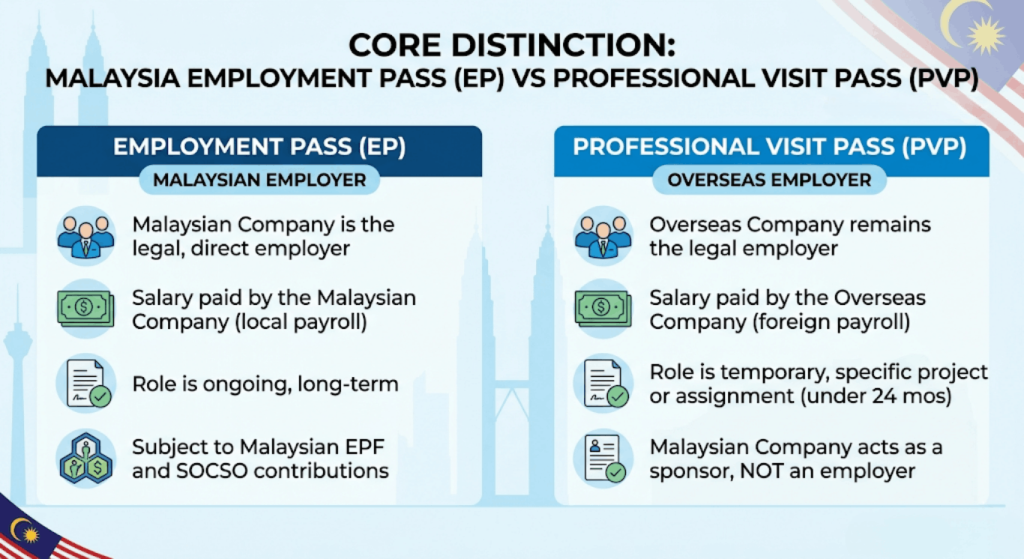
An Employment Pass is for foreign professionals employed and paid by a Malaysian company. The Malaysian entity becomes your legal employer. You will be on Malaysian payroll, subject to EPF and SOCSO contributions.
A Professional Visit Pass is for those who remain employed by an overseas company but need to work temporarily in Malaysia. Your overseas employer continues to pay your salary. The Malaysian entity acts as your sponsor, not your employer.
Applying for the wrong pass will result in rejection.
The one-question test: Who will pay your salary?
If the Malaysian company will pay you directly, you need an Employment Pass. If your overseas employer will continue paying you while you work in Malaysia, you need a Professional Visit Pass.
From 1 June 2026, Employment Pass salary thresholds are increasing significantly, with Category I doubling from RM10,000 to RM20,000.
If you are considering an EP, these changes directly affect your eligibility.
Considering your options for a work permit in Malaysia? Our guide covers eligibility, documents, and timelines for both EP and PVP applications.
Quick Comparison: EP vs PVP
| Criteria | Employment Pass | Professional Visit Pass |
| Employment Relationship | Employed by Malaysian company | Employed by overseas company |
| Salary Paid By | Malaysian company | Overseas company |
| Maximum Duration | Cat I: up to 5 years
Cat II: up to 2 years Cat III: up to 12 months |
Up to 12 months (non-renewable).
Training: 6 months, non-renewable. |
| Minimum Salary (June 2026) | Cat I: ≥RM20,000
Cat II: RM10,000–19,999 Cat III: RM5,000–9,999 (June 2026) |
No minimum: applicant remains on overseas payroll |
| Dependant Pass | Cat I & II: Yes
Cat III: Yes (from June 2026; not permitted under current rules) |
No: dependants not permitted |
| Processing Time | 3–4 weeks (ESD-registered) /
6–10 weeks (including ESD registration) |
14–21 working days |
| Government Fee | RM2,000 | RM1,200 |
| Application Channel | ESD portal | ESD portal |
| Eligible Roles | Managerial, executive, technical | Technical experts, trainers, consultants, researchers |
Our guide on how to hire expatriates in Malaysia covers eligibility requirements and the correct approving agency for your sector.
What Are the New Employment Pass Salary Requirements From June 2026?
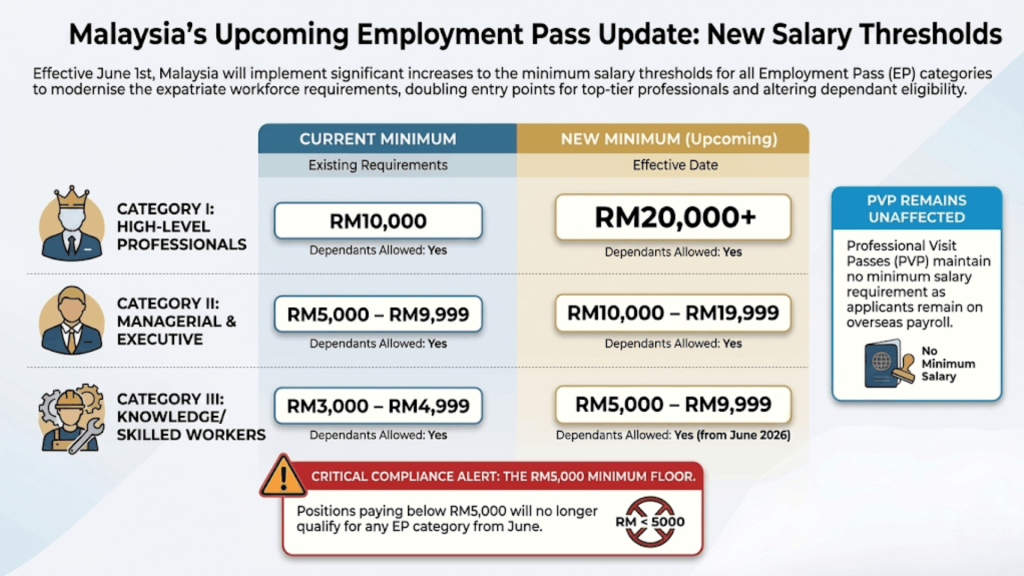
From 1 June 2026, Employment Pass minimum salaries increase significantly. These changes apply to all new and renewal applications submitted from this date.
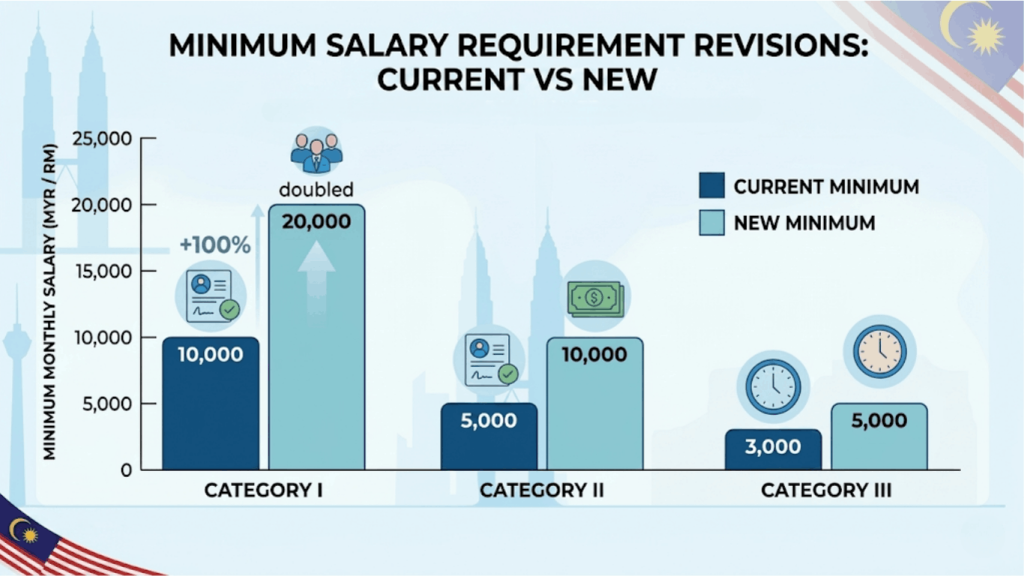
| EP Category | Current Minimum | New Minimum (June 2026) | Max Duration | Dependant Eligibility |
| Category I | RM10,000 | RM20,000+ | 5 years per term, 10 years cumulative | Yes |
| Category II | RM5,000-9,999 | RM10,000-19,999 | 2 years per term, 10 years cumulative | Yes |
| Category III | RM3,000-4,999 | RM5,000-9,999 | 12 months per term, 5 years cumulative | Yes (from June 2026) |
The previous thresholds were established in December 2016. This revision effectively doubles the minimum for Category I.
All figures refer to basic monthly salary only. Allowances, bonuses, commissions, and benefits-in-kind do not count towards the minimum.
An expatriate earning RM18,000 in total compensation but only RM9,000 in basic salary would not qualify for Category I under the new rules.
Positions paying RM5,000 to RM9,999 shift from Category II to Category III, with shorter maximum tenure (5 years vs 10 years) and mandatory succession planning.
Positions paying RM3,000 to RM4,999 will no longer qualify for any EP category from June 2026.
PVP Is Not a Workaround
Professional Visit Pass is not affected by these salary changes. PVP has no minimum salary requirement because the foreign professional remains on their overseas employer’s payroll.
However, some employers assume PVP can absorb roles that no longer meet EP thresholds.
This is a compliance violation waiting to happen. PVP is only appropriate for genuinely temporary engagements where the professional remains employed and paid by an overseas company. Using PVP to circumvent EP salary minimums will trigger enforcement action.
Get Your Application Right the First Time
Need help navigating the June 2026 EP salary changes? Book a 15-minute compliance consultation with Moore Bzi.
Which Pass Do You Need? Decision Framework
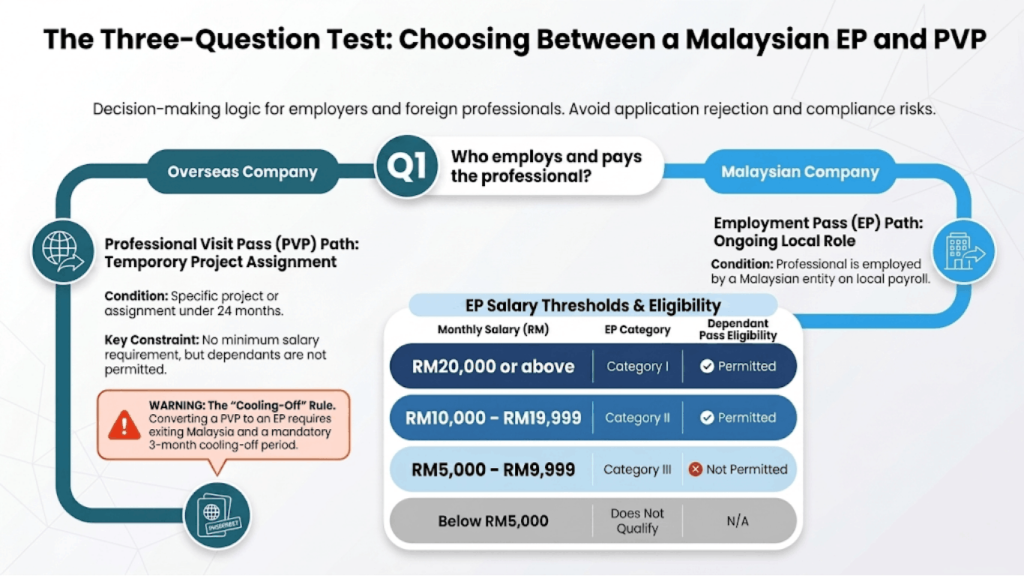
The Three-Question Test
Question 1: Who employs the foreign professional?
- A Malaysian company → Proceed to Question 2 (EP path)
- An overseas company → Proceed to Question 3 (PVP path)
Question 2 (EP Path): Will your Malaysian company pay their salary directly?
- Yes → Employment Pass is required. Check salary thresholds below.
- No → Stop. Clarify the employment arrangement before proceeding.
Question 3 (PVP Path): Is this a temporary, project-specific engagement under 12 months?
- Yes → Professional Visit Pass is likely appropriate.
- No (ongoing or permanent) → PVP is not appropriate. Consider restructuring as EP.
Salary Threshold Check (EP Path)
| Monthly Salary | EP Category | Dependants Allowed |
| RM20,000 or above | Category I | Yes |
| RM10,000 to RM19,999 | Category II | Yes |
| RM5,000 to RM9,999 | Category III | Yes (from June 2026) |
| Below RM5,000 | Does not qualify | N/A |
Edge Cases
Project-to-permanent:
You bring in a consultant on PVP, the project succeeds, and you want to hire them permanently. PVP cannot be converted to EP in-country. A fresh EP application is required, and the professional must exit Malaysia before the new application can proceed.
Under the June 2026 NEEP framework, the EP Category III renewal cooling-off period has been eliminated.
However, PVP-to-EP conversion cooling-off requirements are governed by separate ESD provisions and may still apply. Confirm the latest rules with ESD at the time of application.
Secondments:
A multinational sending an employee from their overseas office to work in Malaysia for 18 months often falls into a grey area. The employment relationship and salary source determine the path, but secondments often require specialist assessment.
When to consult a specialist:
The employment relationship is complex, the salary falls near threshold boundaries, or the activity does not clearly fit either category.
Need clarity on your scenario? Contact Moore Bzi for a compliance consultation. A 15-minute conversation can save weeks of application delays.
Who Can Apply? Eligibility Requirements Compared
Both passes require the Malaysian sponsoring company to be registered with the Expatriate Services Division (ESD).
Company Eligibility
Your company must meet minimum paid-up capital thresholds based on ownership structure.
| Company Ownership | Minimum Paid-Up Capital |
| 100% Malaysian-owned | RM250,000 |
| Joint venture (foreign + local) | RM350,000 |
| 100% foreign-owned | RM500,000–1,000,000
(varies by sector; trading and services companies require the higher threshold) |
Companies that are 100% foreign-owned also require WRT licence clearance before ESD registration if engaged in wholesale, retail, trading, or food and beverage operations.
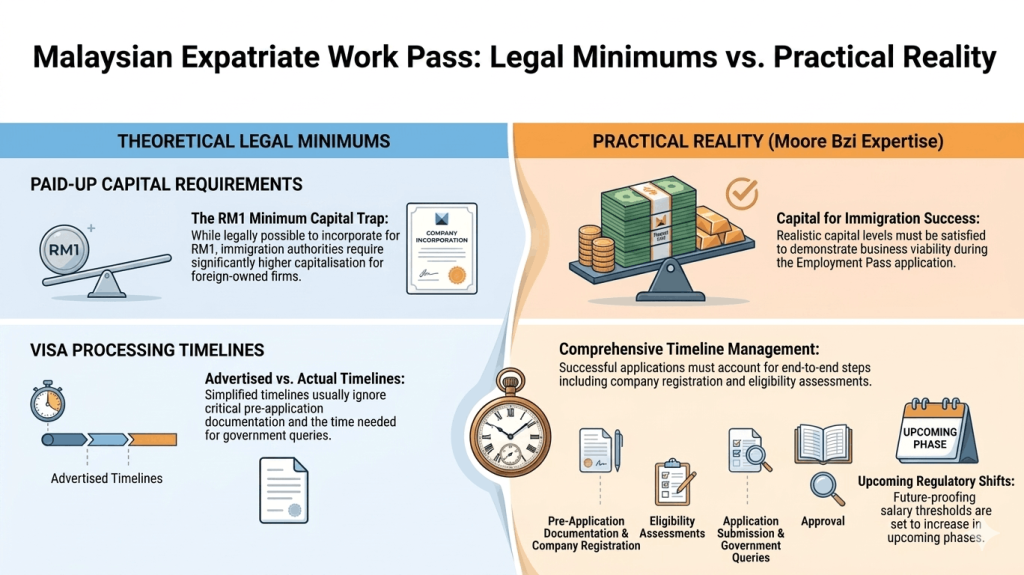
If you are incorporated with RM100 paid-up capital, you will not meet ESD thresholds. These are non-negotiable.
Foreign Professional Eligibility
For Employment Pass:
- Relevant qualifications or equivalent work experience
- Salary meeting category thresholds (June 2026 figures)
- Clean immigration record
For Professional Visit Pass:
- Employed by an overseas company, not the Malaysian sponsor
- Assignment within approved categories: equipment installation, training delivery, consultancy, research, or artistic performances
- Valid contract between overseas employer and Malaysian sponsor
From August 2024, PVP application documents were simplified from 13 to 6 core items: passport copy, application letter from sponsor, letter of award or contract, bonds, Memorandum of Understanding, and supporting documents where applicable for specific assignment types.
Planning to set up a company first? Learn the correct sequence in our guide on how to register a foreign-owned company in Malaysia.
Application Process, Timeline, and Costs
Employment Pass applications take 3–4 weeks if the company is already ESD-registered, or 6–10 weeks including first-time ESD registration.
Professional Visit Pass processing is faster at 14–21 working days.
Step-by-Step Workflow
- ESD Registration – Register your company with ESD (one-time). Meet paid-up capital requirements.
- MYFutureJobs Advertisement (EP only) – Advertise the position for 14 days minimum.
- Application Submission – Submit through the ESD online portal.
- Processing and Approval – ESD reviews the application.
- Visa with Reference (VDR) – Foreign professional applies for entry visa (if required).
- Endorsement at MYXpats Centre – Complete pass endorsement upon arrival.
Realistic Timelines
| Scenario | Expected Timeline |
| EP (company already ESD-registered) | 3–4 weeks |
| EP (first-time, including ESD registration) | 6–10 weeks |
| Professional Visit Pass | 14–21 working days |
Need help navigating the application process? Moore Bzi handles EP and PVP applications daily. Contact us to discuss your situation.
Common Mistakes and Compliance Risks
Mistake 1: Using PVP when the role requires EP
If your Malaysian company employs and pays the professional, PVP is not appropriate.
Consequence: pass cancellation, penalties, blacklisting.
Mistake 2: Paying Local Salary to a PVP Holder
Employment remuneration must come from the overseas entity.
Consequence: compliance audit failure, pass revocation.
Mistake 3: Submitting Applications with Outdated Salary Figures
Positions paying RM3,000 to RM4,999 will no longer qualify.
Consequence: rejection, need to restructure salary or role.
Mistake 4: Failing to Plan PVP-to-EP Transitions
PVP cannot be converted to EP in-country. A fresh EP application is required, and the professional must exit Malaysia.
PVP-to-EP conversion requirements are governed by separate ESD provisions; confirm the latest rules with ESD at the time of application.
Consequence: gap in work authorisation if transition is not planned in advance.
Mistake 5: Ignoring Succession Planning
From June 2026, EP Categories II and III require a formal succession plan with local successor identification, competency transfer protocols, and training milestones.
MOHA pre-approval for EP Category III is no longer required, but the succession plan obligation remains.
Consequence: renewal rejection.
Mistake 6: Overlooking Exit Clearance Obligations
From 18 November 2025, sponsoring companies must complete Exit Clearance via ESD Online within 30 days of pass expiry for both EP and PVP holders who have not renewed or shortened their pass before departure.
This applies to all passes approved through ESD Online from that date onwards.
Consequence: non-compliance restricts ESD portal access, blocking your company from submitting or paying for new EP and PVP applications until the Exit Clearance is completed.
 Freepik
Why Moore Bzi?
Moore Bzi has guided hundreds of companies through Employment Pass and Professional Visit Pass applications over more than 20 years.
- ISO 9001:2015 certified for Provision of Permit Application Services
- Authorised MM2H agent under the Malaysian Ministry of Tourism
- End-to-end service from company registration, business licences, ESD registration to pass endorsement
- Regulatory fluency across ESD, MDEC, MIDA, and sector-specific agencies
Making the Right Decision
The EP vs PVP decision comes down to one question: is the professional employed by your Malaysian company or by an overseas entity?
If your company employs and pays them for an ongoing role, you need an Employment Pass. If they remain employed overseas for a temporary assignment, you need a Professional Visit Pass.
The June 2026 threshold changes make EP eligibility significantly more demanding. But they do not change the fundamental distinction.
The cost of getting it wrong: rejection, delays, penalties.
The value of getting it right: smooth onboarding, workforce stability, compliance confidence.
Get Your Application Right the First Time
Need help navigating the June 2026 EP salary changes? Book a 15-minute compliance consultation with Moore Bzi.
Frequently Asked Questions
What is the difference between Employment Pass and Professional Visit Pass in Malaysia?
The key difference is the employment relationship. An Employment Pass is for foreign professionals employed and paid by a Malaysian company. A Professional Visit Pass is for those employed by an overseas company who temporarily work in Malaysia.
Can I work in Malaysia with a Professional Visit Pass?
Yes, but only for the specific assignment stated on your pass. PVP permits temporary work such as equipment installation, training delivery, consultancy services, or research collaboration.
Which pass has higher salary requirements?
Employment Pass has defined minimum salary thresholds by category. From June 2026: Category I requires RM20,000+, Category II requires RM10,000–19,999, Category III requires RM5,000–9,999. PVP has no minimum salary requirement.
What are the new EP salary requirements from June 2026?
Category I: RM20,000+. Category II: RM10,000–19,999. Category III: RM5,000–9,999. All thresholds refer to basic monthly salary only; allowances, bonuses, and other benefits are excluded.
Do the June 2026 salary changes affect Professional Visit Pass?
No. The salary threshold increases apply only to Employment Pass categories. PVP has no minimum salary requirement.
Can I bring my family on a Professional Visit Pass?
No. PVP does not include provisions for dependants. EP holders in Categories I, II, and III (from June 2026) may sponsor Dependant Passes.
Does my company need ESD registration to sponsor a PVP?
Yes. The Malaysian sponsoring company must be registered with the Expatriate Services Division (ESD) to apply for either EP or PVP.
Is the Employment Pass valid throughout Malaysia?
No. The standard EP is valid for Peninsular Malaysia only. Work in Sabah or Sarawak requires separate state-level approval.
How much does EP cost compared to PVP?
EP costs RM2,000; PVP costs RM1,200. Both increased from RM800 in September 2024. These are government fees only (exclusive of 8% SST).
Can I convert from PVP to Employment Pass?
Yes, but not directly. You must exit Malaysia and submit a fresh EP application. PVP-to-EP conversion cooling-off requirements may still apply; confirm the latest rules with ESD or your immigration consultant at the time of application.
What documents are required for a PVP application?
As of August 2024, PVP requires 6 core documents: passport copy, application letter from sponsor, letter of award or contract, bonds, Memorandum of Understanding, and supporting documents where applicable for specific assignment types.
What happens if I use the wrong type of pass?
Using PVP for what should be EP employment constitutes immigration non-compliance. Consequences include pass cancellation, company penalties, and potential blacklisting.