



27 Apr Can Newly Incorporated Company in Malaysia Apply for a Work Visa?

A newly incorporated company in Malaysia can apply for an Employment Pass. There is no minimum operating period, a company incorporated last month is assessed under the same criteria as one that has been operating for ten years.
What determines success is not how long your company has existed, but whether it meets four requirements: the correct entity type, sufficient paid-up capital, the relevant business licences, and approved registration with the Expatriate Services Division (ESD).
This guide walks you through each one. For a broader overview of work pass types, refer to our foreigner work permit and visa guide. If you would prefer an expert assessment, our team at Moore Bzi is available to guide you from company setup through to Employment Pass approval.
Key Takeaways
- No minimum operating period is required to apply for an Employment Pass in Malaysia
- Only Sdn Bhd, LLP, and subsidiary structures are eligible to sponsor an EP
- Minimum paid-up capital starts at RM500,000 for a 100% foreign-owned company
- 100% foreign-owned trading and consultancy companies must obtain a WRT licence before ESD registration
- End-to-end timeline runs 10–14 weeks without a WRT licence, and 16–22 weeks with one
- First-time EP applications are typically granted for one year regardless of contract length
Which Company Types Can Sponsor an Employment Pass in Malaysia?
 Source: Freepik
Not every registered business in Malaysia can sponsor an Employment Pass. The Expatriate Services Division (ESD), which oversees all EP applications, only accepts company registration from specific entity types.
If your business is registered under the wrong structure, it is ineligible to apply, regardless of how long it has been operating or how much capital it holds.
The ESD accepts registration from the following corporate entity types:
| ✅ Eligible for ESD Registration | ❌ Not Eligible |
| Private Limited Company (Sdn Bhd) | Sole Proprietorship |
| Limited Liability Partnership (LLP) | General Partnership |
| Subsidiary of a Foreign Company | Enterprise (ROB-registered) |
| Public Limited Company (Berhad) | N/A |
Most foreign investors and entrepreneurs incorporate as Sdn Bhd, which is the correct structure. Some founders have been advised to use a sole proprietorship or enterprise for speed or cost reasons; those structures are ineligible and cannot be remedied through an application.
The company must be re-incorporated. Both Sdn Bhd and LLP structures are eligible, but for companies with foreign ownership, the Sdn Bhd is generally the preferred route.
It offers clearer shareholding arrangements, an established track record with immigration authorities, and greater flexibility for future licensing requirements.
If your company is still in the planning stage, a Moore Bzi consultant can advise on the optimal structure before incorporation, contact us through our company registration services in Malaysia page.
Once incorporated, you will also need a licensed company secretary in Malaysia to maintain statutory compliance with the Companies Commission of Malaysia (SSM).
Latest Posts



Not sure if your company structure qualifies?
Tell us your company type, sector, and ownership structure, we will confirm your EP eligibility in one call.

Four Requirements Your New Company Must Meet Before Applying

Source: Freepik
Before a newly incorporated Malaysian company can submit a single Employment Pass application, it must satisfy four prerequisites with the Expatriate Services Division (ESD). These are eligibility gates, not documentation formalities.
A company that does not meet all four will have its ESD registration returned or rejected, which imposes a waiting period before it can reapply.
Paid-Up Capital: The Gap Between the Legal Minimum and the Practical Minimum
While the Companies Act 2016 permits incorporation with as little as RM1, the ESD requires companies to demonstrate sufficient paid-up capital before approving EP sponsorship. The threshold varies by ownership structure and sector.
| Ownership Structure | Sector | Minimum Paid-Up Capital |
| 100% foreign-owned | General / Professional services | RM500,000 |
| 100% foreign-owned | Trading, retail, wholesale, consultancy, restaurant | RM1,000,000 |
| Joint venture (local partner ≥50%) | All sectors | RM350,000 |
| Joint venture (local partner 30–49%) | All sectors | RM500,000 |
These are the minimum thresholds for ESD registration eligibility. Higher capital strengthens approval prospects, particularly when applying for multiple EPs simultaneously.
This is the most common structural error seen in new company EP applications. A founder incorporates with RM10,000 or RM50,000, enough to open a bank account, yet discovers months later that the capital injection required for EP eligibility is ten to fifty times higher.
Increasing paid-up capital after incorporation is possible but requires a board resolution, SSM filing, and a verifiable fund transfer to the company’s corporate bank account.
Check your current paid-up capital against the table above before proceeding. If it falls short, capital injection should be your first action item.
WRT Licence: The Mandatory First Step for Certain Foreign-Owned Companies
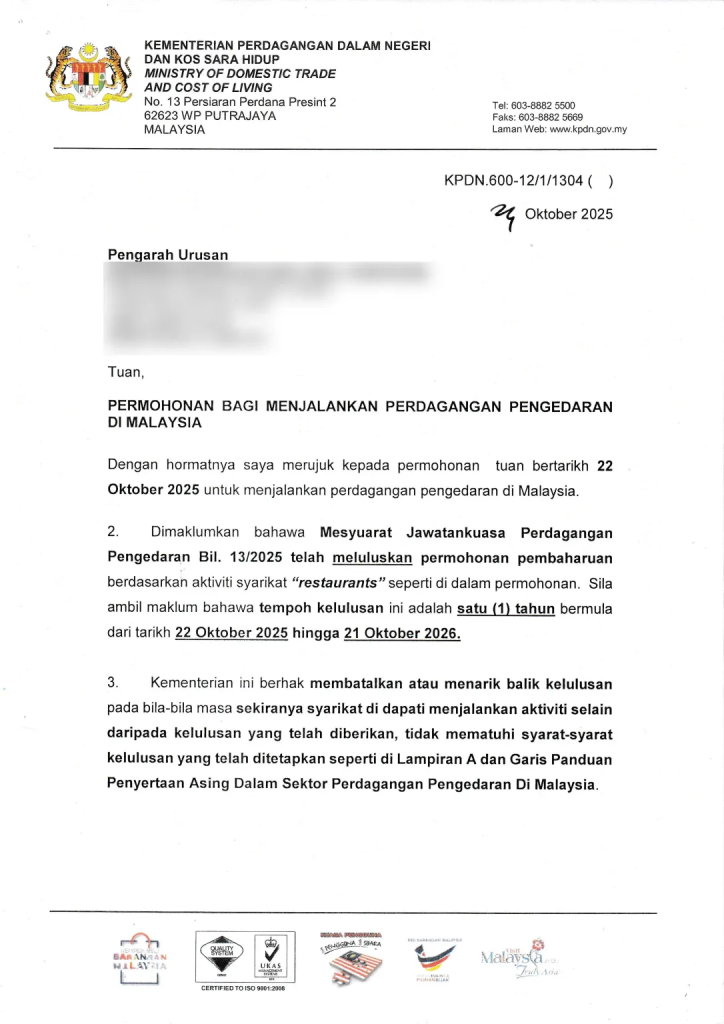 Sample of WRT License
MISHU
If your company is 100% foreign-owned and operates in import/export, wholesale, retail, restaurant, or consultancy/services sectors, you must obtain a Wholesale and Retail Trade (WRT) licence before your ESD registration application will be accepted.
The WRT licence is issued by the Ministry of Domestic Trade and Cost of Living (KPDN) and typically takes four to eight weeks to process.
This is the single most overlooked prerequisite in the EP guide landscape. Companies in the sectors above that attempt ESD registration without a WRT licence will have their application rejected. Discovering this after incorporating and preparing ESD documents can add two months to the timeline.
As stated on Moore Bzi’s ESD service page: for companies that are 100% foreign-owned in import/export, wholesale, retail, restaurant, or consultancy/services, it is mandatory to obtain the WRT licence before proceeding with ESD registration.
If your company falls into any of these sectors, the WRT licence application should begin immediately, before ESD registration documents are even prepared.
Office Address: Physical or Virtual, But Not a Home or SOHO
ESD registration requires a valid tenancy agreement with a minimum of 12 months remaining validity, along with office photographs and a business signage photograph. A physical office, virtual office, or serviced office is acceptable.
A home address, SOHO (Small Office/Home Office) unit, or residential address is not accepted. New companies often use a home address as a temporary measure during early operations, which is workable for incorporation but will cause an ESD registration rejection.
If your company currently uses a home or SOHO address, arrange a virtual office in Malaysia or serviced office and update your address with SSM before initiating ESD registration.
ESD Company Registration: The Gateway Before Any EP Can Be Submitted
Before any individual Employment Pass application can be submitted, the company itself must complete ESD registration and receive approval from the Immigration Department of Malaysia via the Expatriate Services Division portal.
This is a one-time, company-level approval; once granted, the company can submit EP applications for individual roles through the Xpats Gateway portal. This two-stage process surprises many first-time applicants who assume the EP application goes directly to Immigration.
Processing takes approximately 14 working days once all documents are in order. Build this into your hiring timeline before committing to a candidate start date, and ensure your company holds the relevant business licence in Malaysia before submitting ESD documents.
Employment Pass Category I vs Category II: Which Does Your New Company Need?

Source: Freepik
Malaysian Employment Passes are divided into categories based primarily on the expatriate’s monthly salary. For most newly incorporated companies hiring senior professionals or executives, the relevant categories are Category I and Category II.
The distinction matters because it affects contract duration, dependent eligibility, and the renewal pathway.
| Category I | Category II | |
| Monthly Salary | RM10,000 and above | RM5,000–RM9,999 |
| Contract Duration | Up to 5 years | Up to 2 years |
| Renewable? | Yes | Yes |
| Bring Dependants? | Yes (spouse, children, parents) | Yes (spouse, children) |
| Domestic Helper Eligible? | Yes | No |
| Typical Roles | CEO, MD, Director, Key Post | Manager, Engineer, Specialist |
Salary thresholds are subject to revision effective 1 June 2026. Refer to our guide on how to hire expatriates in Malaysia for the updated figures and their implications, or contact Moore Bzi for confirmation.
Apply Category I if the monthly salary is RM10,000 or above and the role is a key post. Apply Category II if the salary is RM5,000 to RM9,999 and the role is managerial or professional. For the full eligibility criteria and application steps, refer to our detailed Employment Pass Malaysia guide.
For a comparison of work pass types, including whether an Employment Pass in Malaysia or a Professional Visit Pass is appropriate for your specific hire, refer to our EP vs PVP guide.
One important note for new companies: Immigration typically grants a one-year Employment Pass for first-time applications, regardless of the contract duration stated. This is standard practice and not a reflection of weakness in the application.
The EP is assessed for renewal at the one-year mark based on the company’s compliance record and business activity.
The Realistic Timeline: From Incorporation to First Working Day

Source: Freepik
The total time from company incorporation to an expatriate’s first working day in Malaysia ranges from approximately three to five months for a new company.
This is not a single application with one processing window; it is a sequential chain of approvals, each dependent on the previous stage being completed correctly.
| Stage | Estimated Duration | Notes |
| Company incorporation (SSM) | 1–2 weeks | One-time; must be Sdn Bhd or LLP |
| Paid-up capital injection | 1–2 weeks | Must be reflected in bank statements before ESD submission |
| WRT licence application (if required) | 4–8 weeks | 100% foreign-owned trading/consultancy companies only |
| ESD company registration | 2–3 weeks (~14 working days) | One-time company-level approval; required before any EP can be submitted |
| MyFutureJob advertisement (if required) | Minimum 30 days (runs concurrently) | Required for positions below RM15,000/month; can run during ESD registration stage |
| Position approval | 1–2 weeks | Sector-dependent; MIDA, MDEC, BNM, or Expatriate Committee |
| EP application processing | 1–2 weeks (5–7 working days) | Once position is approved and documents are complete |
| Visa With Reference (VDR) + entry (if required) | 2–4 weeks | Applicant outside Malaysia; varies by embassy/consulate |
| EP sticker endorsement at Immigration / MYXpats | 1 week | After arrival in Malaysia; activates EP |
| Total (without WRT licence) | ~10–14 weeks (2.5–3.5 months) | Best case; assumes documents are complete and no queries raised |
| Total (with WRT licence) | ~16–22 weeks (4–5.5 months) | For 100% foreign-owned trading/consultancy sectors |
For positions with a monthly salary below RM15,000, the company must advertise the vacancy on the MyFutureJob portal for a minimum of 30 days before the EP application is submitted. This 30-day period can run concurrently with the ESD registration period if timed correctly. Missing this step adds a full month to the timeline.
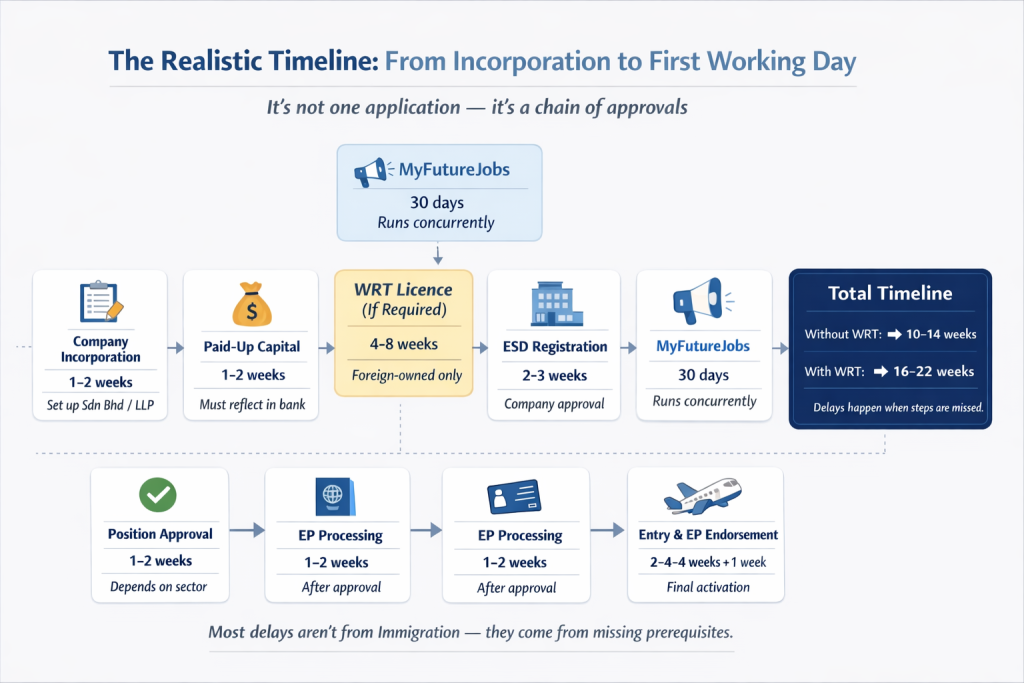
Positions with a monthly salary of RM15,000 or above are exempt from the MyFutureJob advertisement requirement. Once the EP is approved, the expatriate’s pass is endorsed at the MYXpats Centre or a designated Immigration counter after arrival in Malaysia.
For sector-specific position approvals, the relevant agency may be MDEC for digital and ICT roles, MIDA for manufacturing, or the Expatriate Committee for general services. Once your company is up and running with expatriate staff, you may also want to explore our payroll outsourcing services and foreign worker income tax obligations to stay compliant.
Found a gap in your readiness checklist?
Fix it before it costs you a rejected application and months of delay. Our consultants review your entity structure, paid-up capital, WRT licence requirement, and ESD eligibility before a single document is prepared.
Four Mistakes Newly Incorporated Companies Make (And How to Avoid Them)

Source: Freepik
Most delays and rejections in new company EP applications are not caused by weak candidates. They are caused by avoidable company-side errors that general EP guides do not flag. These are the four patterns Moore Bzi’s consultants see most often.
Mistake 1: Incorporating with RM1 Paid-Up Capital
Founders who incorporate with the legal minimum of RM1 may not realise this disqualifies them from EP sponsorship until they reach the ESD registration stage, sometimes months after incorporation.
Fix: Inject the appropriate capital level based on your ownership structure and sector at incorporation. If already incorporated below the threshold, begin the capital increase process immediately.
Mistake 2: Proceeding with ESD Registration Without a WRT Licence
100% foreign-owned companies in trading, retail, wholesale, consultancy, or restaurant sectors that submit ESD registration without a WRT licence will have their application returned.
Fix: Before preparing any ESD documents, confirm whether your sector and ownership structure require a WRT licence. If it does, submit the WRT licence application first.
Mistake 3: Using a Home Address or SOHO as the Registered Office
ESD requires office photographs, a business signage photograph, and a tenancy agreement with at least 12 months of remaining validity. Home addresses and SOHO units fail this requirement and will cause ESD registration to be returned.
Fix: Arrange a virtual office or serviced office address before initiating ESD registration, and update SSM records to reflect the new address.
Mistake 4: Forgetting the MyFutureJob Advertisement Requirement
For positions with a monthly salary below RM15,000, the company must advertise the role on MyFutureJob for a minimum of 30 days before submitting the EP application. Companies that skip this step have their EP application rejected upon submission review.
Fix: Post the MyFutureJob advertisement on the same day ESD registration documents are submitted; the 30 days run concurrently, saving approximately four weeks on the overall timeline.
Our pre-application readiness assessment reviews all four of these areas before a single ESD document is prepared, so that the application process moves forward without interruption.
Ready to Begin Your Employment Pass Application?
Applying for an Employment Pass as a newly incorporated company is entirely possible, but getting the prerequisites right from the start is what determines whether your application moves forward smoothly or hits avoidable delays.
Moore Bzi’s consultants have guided companies through this process for over 20 years, from ESD registration and WRT licence applications to full Employment Pass approval.
Whether your company is still in the planning stage or already incorporated and ready to begin, we are here to assess your eligibility and guide you through every step.
Contact Moore Bzi today. Fill in our contact form and a consultant will respond to discuss your company’s EP readiness.
Prefer a quicker response? Message us on WhatsApp: 03-77281807 (Monday to Friday, 9.00am–6.00pm).
Moore Bzi Sdn. Bhd.
Ready to move forward? Let Moore Bzi handle it.
From ESD registration and WRT licence applications to full Employment Pass approval, we have guided newly incorporated companies through this process for over 20 years. Fill in our contact form and a consultant will respond within one business day.
FAQ
Can a newly incorporated company in Malaysia apply for an Employment Pass?
Yes. There is no minimum operating period for Employment Pass eligibility. A company incorporated last week can apply, provided it meets the four prerequisites: correct entity type, sufficient paid-up capital, any required sector licences, and approved ESD company registration.
How much paid-up capital does a new company need to apply for Employment Pass in Malaysia?
For a 100% foreign-owned Sdn Bhd in general or professional services, the minimum is RM500,000. For trading, retail, wholesale, or consultancy sectors, the minimum is RM1,000,000. Joint ventures where a Malaysian partner holds at least 50% may qualify with RM350,000.
How long does it take for a new company to get Employment Pass approval in Malaysia?
From incorporation to the expatriate’s first working day, budget 10–14 weeks for companies that do not require a WRT licence, and 16–22 weeks for those that do. ESD company registration takes approximately 14 working days, and the EP application adds a further 5–7 working days once documents are complete.
Does my new company need a WRT licence before applying for Employment Pass?
Only if the company is 100% foreign-owned and operates in trading, retail, wholesale, restaurant, or consultancy/services sectors. In those cases, the WRT licence must be obtained before ESD registration is accepted. Other sectors and joint ventures with Malaysian partners are generally exempt.
What can a new company submit instead of audited financial statements for ESD registration?
New companies without audited accounts can typically submit management accounts, bank statements reflecting the paid-up capital injection, and a business plan or financial projection letter. The specific documents accepted may vary by sector and company profile, contact Moore Bzi for guidance on what applies to your situation.