



26 Mar How to Hire Expatriates in Malaysia: Eligibility, Process & 2026 Updates

Most guides on hiring expatriates in Malaysia will cost you weeks of wasted effort.
They mention the Expatriate Services Division (ESD) as if it is the only pathway, cite salary thresholds that become obsolete in June 2026, and gloss over eligibility requirements that determine whether your application succeeds or fails before you even submit it.
This guide takes a different approach.
To hire an expatriate in Malaysia, your company must meet minimum paid-up capital requirements, register with ESD, and obtain position approval from the relevant agency.
For many employers, this process becomes complicated, especially when navigating ESD registration, agency approvals, and documentation requirements. This is where experienced immigration consultants like Moore Bzi help companies avoid delays and manage the process efficiently.
From 1 June 2026, minimum salary thresholds increase significantly: Category I rises to RM20,000, Category II to RM10,000, and Category III to RM5,000. First-time employers should realistically expect six to eight weeks from registration to passport endorsement, not the two to three weeks many guides suggest.
If you are an HR manager, business owner, or operations director preparing to bring foreign talent into your Malaysian company, this guide will tell you exactly what you need to know.
Key Takeaways
- Eligibility first: Your company must have RM250,000 to RM1,000,000 in paid-up capital and be registered with SSM before applying
- Agency routing matters: There are 10 different approving agencies; applying to the wrong one causes rejection or weeks of delay
- June 2026 salary changes: Category II minimum rises from RM5,000 to RM10,000. Applications with outdated figures will be rejected
- Realistic timeline: First-time employers should expect six to eight weeks, not two to three
- Decision rule: If you are unsure about eligibility or agency routing, engage a visa agent in Malaysia to avoid costly rejections
Can Your Company Hire an Expatriate?
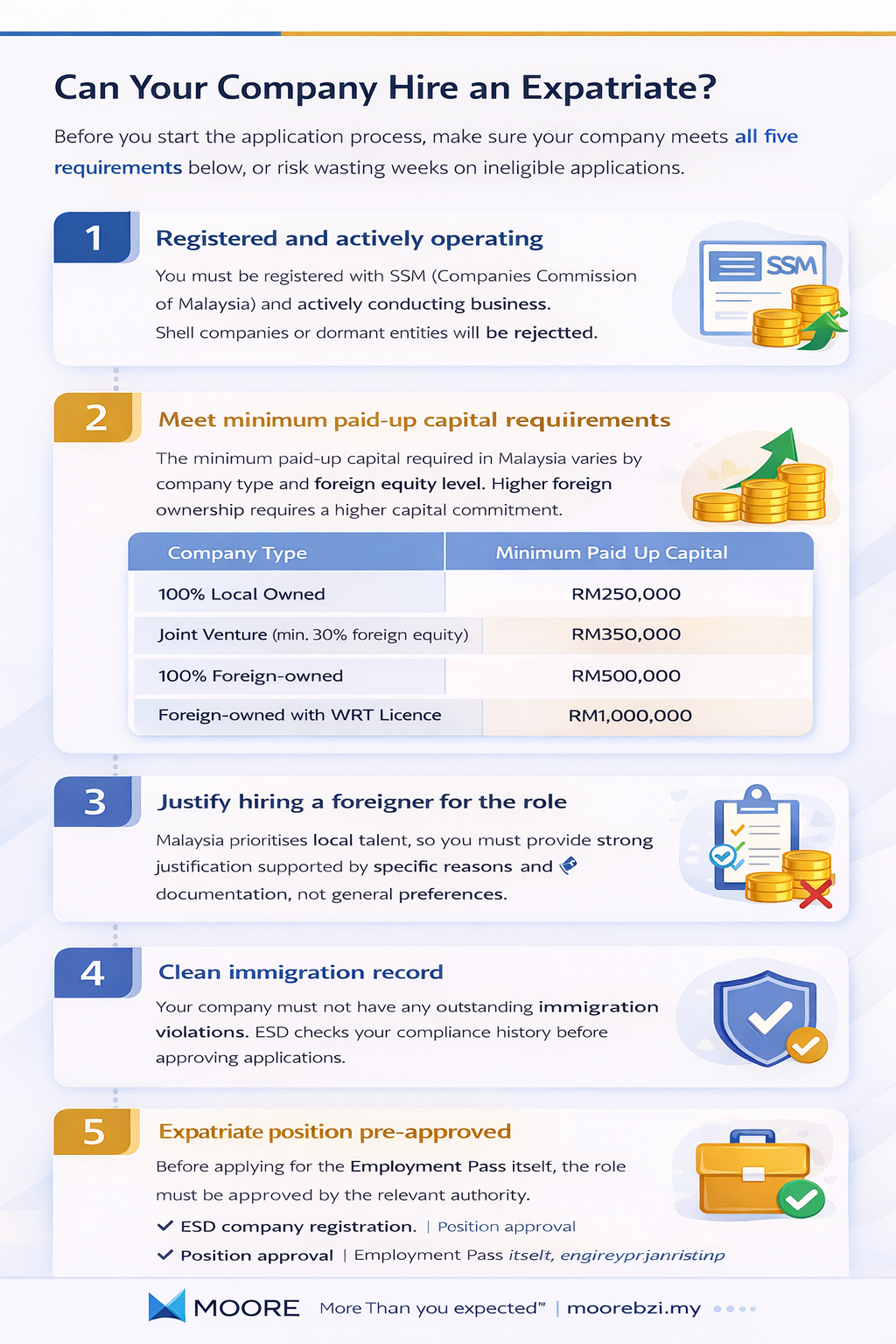
Before you start the application process, confirm your company meets these five requirements. Many employers waste weeks on applications that get rejected because they did not check eligibility first.
1. Your company must be registered with SSM and actively operating.
Only companies registered with the Companies Commission of Malaysia (SSM) can sponsor expatriates. Shell companies or dormant entities will be rejected.
2. You must meet minimum paid-up capital requirements.
Paid-up capital is the actual amount of money a company’s shareholders have contributed to the business. It is often used as one indicator of the company’s financial strength.
So, based on the table below, the minimum paid-up capital requirement in Malaysia varies by company type, with foreign ownership generally requiring a higher capital commitment.
| Company Type | Minimum Paid-Up Capital |
| 100% Local Owned | RM250,000 |
| Joint venture (minimum 30% foreign equity) | RM350,000 |
| 100% Foreign-owned | RM500,000 |
| Foreign-owned with WRT licence | RM1,000,000 |
If your company does not meet the minimum paid-up capital requirement, it may not be eligible to register through ESD to hire expatriates.
Foreign-owned companies may also need specific business licences required for foreign investors, depending on their sector, particularly if trading activities are involved.
3. You must justify why a local cannot fill this role.
Malaysia prioritises local employment. Every expatriate application requires employers to demonstrate that the position demands skills, qualifications, or experience genuinely unavailable in the local talent pool.
“We prefer this candidate” is not sufficient justification. Neither is “they have more experience” without specifics.
ESD and other approving agencies assess whether the role genuinely requires foreign expertise. Weak or vague justifications result in rejection.
Strong justifications typically include:
- Specialised technical expertise
- Senior management roles
- Intra-company transfers
- Niche industry experience
Weak justifications include:
- Generic management roles
- Trainable positions
- Language-only requirements
The stronger your documentation, the smoother your approval. Include the candidate’s CV highlighting unique qualifications, a detailed job description explaining technical requirements, and evidence that you attempted local recruitment (unless exempt from MYFutureJobs).
If you are new to hiring foreign talent, our employer’s guide to foreign worker permits covers the full landscape of visa options available to Malaysian companies.
4. Your company must not have immigration violations.
ESD checks your company’s compliance history during registration. Companies with previous violations face heightened scrutiny, delayed processing, or outright blacklisting.
Violations that trigger red flags include:
- Employing foreign workers without valid permits
- Failing to cancel Employment Passes for staff who have departed
- Overstayers linked to your company’s sponsorship
- Misuse of visit passes for employment purposes
- Providing false information in previous applications
If your company has a clean record, this requirement is straightforward. If you are unsure of your compliance status, particularly if you have previously employed foreign workers or experienced staff departures, conduct an internal audit before applying.
Companies with past violations are not automatically disqualified, but you may need to provide additional documentation, submit a letter of explanation, or demonstrate corrective measures taken.
A visa agent can help assess your standing and advise on remediation steps if needed.
5. The expatriate position must be approved before you apply for the pass.
This two-step process confuses many first-time employers. You do not apply directly for an Employment Pass for your candidate. You apply for a position first, then for the person.
The correct sequence is:
- ESD company registration: Register your company with ESD (one-time process) and sign the Letter of Undertaking (LoU).
- Position approval: Apply for approval of the expatriate position itself. This submission includes the job title, job scope, salary, reporting structure, and justification for why the role requires foreign expertise. The approving agency assesses whether the position merits an expatriate hire.
- Employment Pass application: Once the position has been approved, you can submit the Employment Pass application for your selected candidate. This stage usually includes the candidate’s personal documents, qualifications, and employment contract.
Many employers assume they can skip straight to submitting the candidate’s application. They cannot. Position approval is a separate gate that must be cleared first.
This structure exists because Malaysia wants to verify that the role itself warrants foreign talent before evaluating the individual candidate.
A highly qualified candidate will still be rejected if the position approval was not obtained or if the role does not meet the criteria for expatriate hiring.
Which Agency Should You Apply To?
Most guides tell you to apply through ESD. That is only part of the picture.
Malaysia has 10 different agencies authorised to approve expatriate applications. Your approving agency depends on your company’s sector, not your preference. Applying to the wrong one causes delays or rejection.
| Sector / Company Type | Approving Agency |
| General services, trading, retail | ESD (Expatriate Services Division) |
| Manufacturing (with MIDA incentives) | MIDA |
| Digital, tech, MSC-status companies | MDEC |
| Iskandar Malaysia zone companies | IRDA |
| Biotechnology sector | BioEconomy Corporation |
| Oil and gas (upstream) | PETRONAS |
| Construction sector | CIDB |
| Education (private institutions) | Ministry of Education / EMD |
| Healthcare (private hospitals) | Ministry of Health |
| Financial services (licensed) | Bank Negara Malaysia / Securities Commission |
Because each sector has a different approving agency, many employers submit to the wrong authority and face unnecessary delays.
Moore Bzi helps companies identify the correct approving agency, handle ESD registration, and manage the full expatriate hiring process across all sectors.f
Latest Posts
-

How to Hire Expatriates in Malaysia: Eligibility, Process & 2026 Updates
Learn how to hire expatriates in Malaysia: eligibility requirements, the correct approving agency for your sector, and critical June 2026 salary threshold changes....
26 March, 2026 -

-

Choose the Right Approving Agency from the Start
Submitting to the wrong agency can delay your expatriate hiring. Our specialists help you identify the correct authority and guide your application for a smoother approval process.

Employment Pass Categories and June 2026 Salary Changes
If you are reading guides that mention RM5,000 as the minimum salary for Employment Pass, that information becomes dangerously outdated from 1 June 2026.
| Category | Current Minimum | June 2026 Minimum | Validity | Dependants |
| Category I | RM10,000 | RM20,000 | Up to 5 years | Yes |
| Category II | RM5,000 | RM10,000 | Up to 2 years | Yes |
| Category III | RM3,000 | RM5,000 | Up to 12 months | No |
If your employment contract states RM8,000 for a Category II role, that application will be rejected after June 2026. You need RM10,000 minimum.
Succession planning is a new requirement for Category II and III from June 2026. Employers must demonstrate a plan to train local staff to eventually fill the role.
These changes were announced by the Immigration Department and confirmed by KPMG, MDEC, and major law firms. If you have already drafted contracts with the old figures, revise them before submitting your Malaysia work visa application.
The Employment Pass is one of several types of work permits in Malaysia available to foreign professionals, each with different eligibility criteria and validity periods.
Step-by-Step Process to Hire an Expatriate
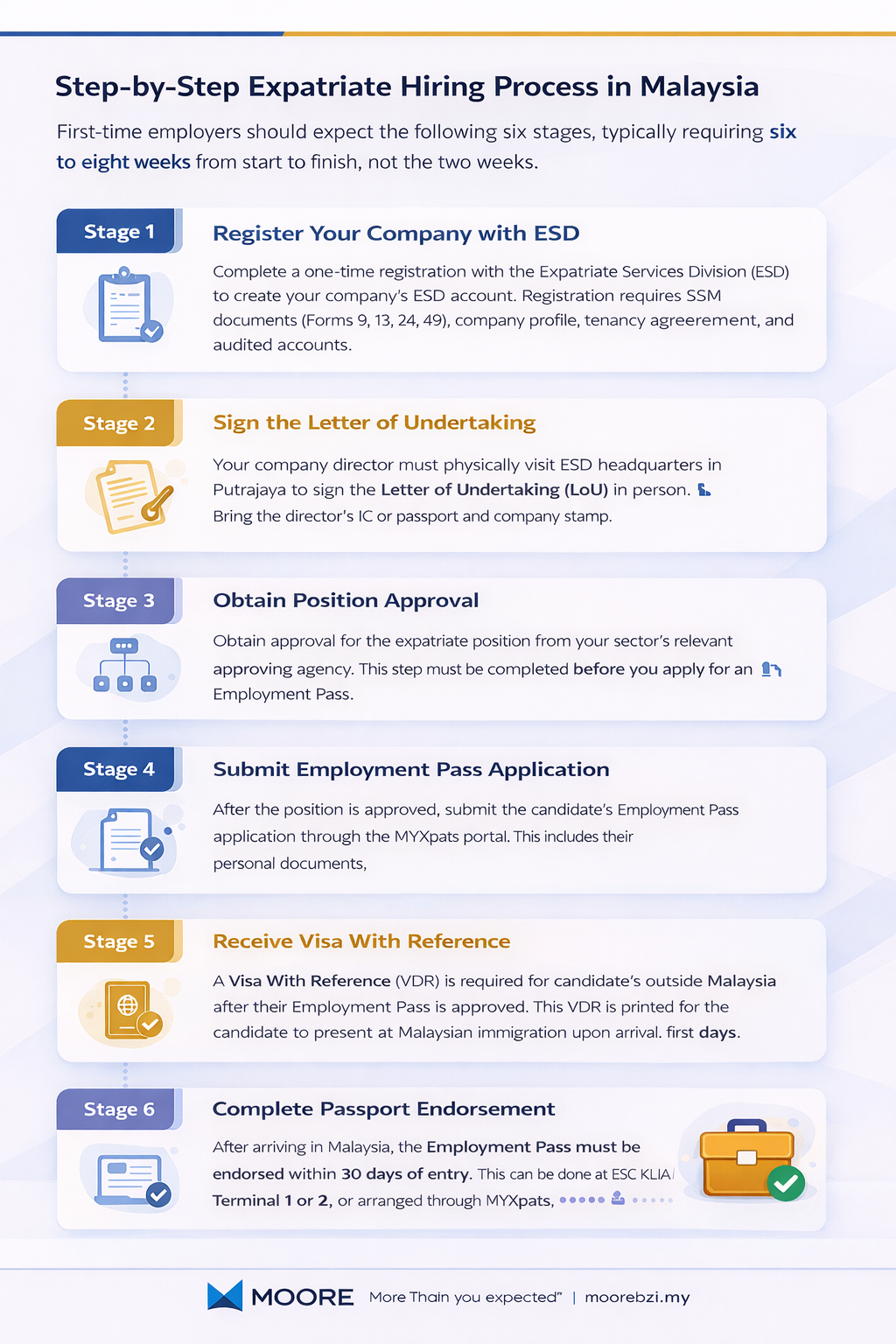
The expatriate hiring process in Malaysia follows six stages. First-time employers should expect six to eight weeks from start to finish, not the two to three weeks some guides suggest.
Stage 1: Register your company with ESD
Complete a one-time registration via ESD. This creates your company’s ESD account. You cannot submit any expatriate applications without it.
Registration requires SSM documents (Forms 9, 13, 24, 49), company profile, tenancy agreement, and audited accounts. Incomplete submissions are rejected immediately.
Many first-time employers underestimate this step. ESD registration requires precise documentation and verification. Incomplete submissions are commonly rejected, delaying the entire hiring timeline.
Moore Bzi assists companies with ESD registration, document preparation, and compliance checks to ensure applications are submitted correctly the first time.
Stage 2: Sign the Letter of Undertaking
A company director must physically visit ESD headquarters in Putrajaya to sign the Letter of Undertaking (LoU). This in-person requirement surprises many employers.
You cannot skip this step. No LoU signature means no account activation. The appointment is scheduled after your online registration is verified. Bring the director’s IC or passport and company stamp.
Stage 3: Obtain position approval
Before applying for the Employment Pass itself, you must obtain approval for the expatriate position from your approving agency.
This is a two-step process that confuses first-timers. You are not applying for a person yet. You are applying for permission to fill a position with a foreign professional. This requires justification, proposed salary, job scope, and reporting structure.
Stage 4: Submit Employment Pass application
Once the position is approved, submit the candidate’s application through the MYXpats portal. This includes their personal documents, qualifications, and employment contract.
Incomplete documents or unverified qualifications cause rejection at this stage.
Stage 5: Receive Visa with Reference
If the candidate is outside Malaysia and requires a visa to enter, the next step is to obtain a Visa with Reference (VDR) after pass approval.
The VDR is the entry authorisation issued through Malaysia’s immigration system for travel into the country, while the Employment Pass is the work permit itself.
Stage 6: Passport endorsement
After the expatriate arrives in Malaysia, the Employment Pass must be endorsed within the required period. ESD states that applications submitted from outside Malaysia must complete endorsement within 30 days after arrival.
Endorsement can be handled through the MYXpats process, including submission and delivery arrangements or collection at ESC KLIA Terminal 1 or Terminal 2, and the official processing timeline is up to three working days upon complete submission.
MYFutureJobs: When Required and When Exempt
MYFutureJobs is Malaysia’s national employment portal. Before submitting most Employment Pass applications, employers must advertise the position on this portal for 14 days and demonstrate that no suitable local candidate is available.
This is called labour market testing. After the advertising period, you must submit a Hiring Outcome Report documenting how many local applicants you received, how many were interviewed, and why each was unsuitable. PERKESO’s approval letter is required before ESD will accept your application.
If your position is not exempt, add 14 to 21 days to your timeline for advertising and report processing.
Exemption Categories
Certain positions skip this requirement entirely:
| Exemption Category | Description |
| C-suite and key posts | CEO, CFO, COO, Managing Director, and equivalent top management roles |
| High earners | Basic monthly salary of RM15,000 or above (bonuses and allowances do not count) |
| Intra-company transfers | Employees transferred from overseas parent company or affiliate |
| Specialists with rare skills | Niche expertise demonstrably unavailable locally |
| MSC-status companies | Certain MDEC-approved positions |
| MIDA-approved manufacturers | Positions already vetted through MIDA’s approval process |
How to Claim an Exemption
Exemptions are not automatic. You must document and justify the claim with supporting evidence: organisational charts for key posts, employment contracts showing RM15,000+ basic salary, or corporate relationship documents for transfers.
If ESD determines your exemption claim is invalid, your application may be returned or rejected, adding four to six weeks while you complete advertising retrospectively.
When in doubt, complete the MYFutureJobs advertising. The 14-day delay is far less costly than a rejected application.
Documents Required and Common Mistakes

Company Documents
- SSM Forms 9, 13, 24, 49 (must be current)
- Company profile with business activities
- Audited financial statements (latest 2 years)
- Tenancy agreement (registered business address)
- Organisational chart showing expatriate position
Employee Documents
- Valid passport (minimum 18 months validity)
- Academic certificates (translated if not in English or Malay)
- Professional certifications
- Detailed CV with employment history
- Signed employment contract with a compliant salary
- Passport-sized photos (white background, recent)
Common Mistakes
- Short passport validity
- Salary below category requirements
- Weak job justification
- Incomplete company documents
Timeline and Costs: What to Realistically Expect
Government processing standards state 10 to 20 working days for Employment Pass approval. In practice, first-time employers should expect six to eight weeks from ESD registration to passport endorsement.
The difference matters. If you are planning around a candidate’s start date, build in buffer time.
| Scenario | Realistic Timeline |
| First-time employer (full process) | 6 to 8 weeks |
| Subsequent hire (ESD account active) | 3 to 4 weeks |
| With MYFutureJobs advertising | Add 30+ days |
First-time employers often experience delays due to incomplete documents or incorrect submissions.
With structured support from experienced consultants such as Moore Bzi, companies can streamline document preparation, coordinate ESD registration, and manage approvals more efficiently.
Where does the time goes
Hiring an expatriate in Malaysia involves more than just Employment Pass approval. First-time employers must also complete ESD registration, Letter of Undertaking (LoU) signing, position approval, and passport endorsement, which is why the full process usually takes longer.
The often-quoted 10 to 20 working days applies only to the Employment Pass processing stage, not the full end-to-end timeline.
Costs to budget for
| Cost Item | Estimated Range |
| ESD company registration | RM200 to RM500 |
| Employment Pass (per year) | RM90 to RM150 |
| Multiple-entry visa | RM500 to RM1,000 |
| Document translation | RM200 to RM800 |
| Visa agent fees (if engaged) | RM2,000 to RM5,000+ |
Fees change periodically. Verify current rates with ESD or your approving agency before budgeting.
Avoid Delays and Unexpected Costs
Get expert guidance on timelines, documentation, and approval requirements before starting your expatriate application.
Why Choose Moore Bzi?
Moore Bzi has guided employers through Malaysia’s expatriate immigration system for over 20 years. Here is what we bring to your application:
- 20+ years of immigration expertise : We handle Employment Pass applications daily and know exactly which documents satisfy ESD queries, how to justify position approvals, and how to navigate the June 2026 salary threshold changes.
- All 10 agency pathways covered: From ESD registration for general services to MIDA, MDEC, IRDA, and sector-specific bodies, we identify the correct agency for your sector before you waste weeks on the wrong application.
- Authorised MM2H agent: Sanctioned by the Malaysian Ministry of Tourism, reflecting our compliance track record with Malaysian immigration authorities.
- Full corporate support: Beyond visas, we offer company registration, company secretarial services, business licences, WRT licences, and Professional Visit Pass applications.
- Proactive compliance checks : We verify paid-up capital, SSM status, document completeness, and salary alignment before submission, catching problems before ESD rejects your application.
- Honest timelines: We tell clients to expect 6 to 8 weeks for first-time applications because that is the reality. Our estimates are based on hundreds of applications, not best-case scenarios.
Conclusion
You now have everything you need to hire an expatriate in Malaysia: the eligibility checklist, the correct agency for your sector, the June 2026 salary thresholds, and a realistic timeline.
The question is whether to handle this yourself or get expert support.
DIY works if your company clearly qualifies, your candidate’s salary exceeds the new thresholds, and you have time to manage the process.
If you are unsure about eligibility, agency routing, or documentation, engaging an experienced consultant like Moore Bzi can help reduce delays and avoid rejected applications.
Frequently Asked Questions
Can SMEs hire expatriates in Malaysia?
Yes, if they meet minimum paid-up capital requirements, are registered with ESD, and can justify why the role requires foreign expertise. Company size alone does not disqualify you.
What if my company were recently incorporated?
Newly incorporated companies can apply, but may need to provide management accounts rather than audited financials. ESD may scrutinise your justification more closely.
Who applies for the Employment Pass?
The employer applies on behalf of the expatriate. Employees cannot apply themselves. The sponsoring company must be registered with ESD.
What happens if my application is rejected?
Rejected applications can be appealed with additional documentation. Review the rejection letter carefully and address each point before resubmitting.
Can I start the process while my candidate is overseas?
Yes. This is standard. You complete ESD registration, position approval, and the application while the candidate is overseas. They enter Malaysia after receiving the VDR.
Can my expatriate bring their family?
Category I and II holders can apply for Dependant Passes for their spouse and children under 18. Category III holders are not eligible.